Issue 1 - August 2026
Hello, everyone, and welcome to the first issue of the new monthly newsletter format on Growing with Professor Brown! Today I'm going to share a bit of information on tomorrow's live stream (Monday, August 31st, 2026) before we jump into our main article on nursery logs! What is a nursery log, and how does it help support the garden? Keep reading to find out!
Welcome to the New Format
Why the new format, and what actually changed? If you're not wondering, feel free to skip ahead.
I started this newsletter to bring past students and the public into what I was already sharing in my weekly student emails — announcements, local events, articles, all in one place. That was the idea, anyway. In practice, I was trying to do too much in one space, and once the semester got busy, I couldn't keep up with the articles. The newsletter slowly turned into a glorified student bulletin, which isn't what some of you signed up for, and it isn't what I wanted to offer either.
So here's the split going forward. Student announcements now go out strictly through official channels, with a new Student Bulletin page archiving them in case an email gets lost along the way. The newsletter itself is monthly now, which gives me the room to actually research and write instead of scrambling every week. The goal isn't to make it longer — just better.
Starting next month, readers will also be able to submit to the newsletter — articles, poetry, prose. If that's something you'd be interested in, keep an eye out. Instructions are coming soon.
Monday Live Streams
The Monday Live Streams are back. We had to skip last week thanks to 100-degree heat, but this Monday is looking mild, with highs under 90. Not quite fall weather yet, but I'm still looking forward to it!
I'll continue the garden tour and check in on how everything handled the heat, then move into assessing and summer-pruning the three new fruit trees.
One thing to note: with the newsletter moving to monthly, this is no longer where you'll find livestream links each week. If you want those reminders, subscribe on YouTube and turn on notifications, or join the email notification list — you can unsubscribe any time.
Join live on 8/31/26 at 6pm: youtube.com/live/jAKwxe29m-U
Local Events
Each issue, I'll highlight what's current here, but the full, up-to-date list will always live on the Local Events & Sales page, which I'll add to as things come in. Worth bookmarking if you want to catch things that pop up between issues.
This Month
Sale — Glendora Gardens Labor Day Sale
Saturday, September 5 – Monday, September 7, 2026
This sale includes 25% off almost everything in the store, and free boba on Saturday, September 5th! (11 am - 3 pm only).
Sale details at Glendora Gardens
In The Garden: Nursery Logs
You're on a hike, and you notice an old tree you've known for years. One of its large branches has broken off, tumbled down the slope, and come to rest. Up close, it's clearly been decaying for a while — mushrooms poke through gaps in the sloughing bark, breaking down the lignin, slowly turning the wood hollow and sponge-like. But look a little closer, and you'll notice something else: small plants growing around it, insects moving through it, signs of life everywhere. This branch isn't dead. It's become a nursery.
That's what a nurse log is — a habitat for new life, and for the organisms that keep a garden running. Some people worry that wood on the ground invites termites, and that's a fair concern near a wood-framed house. But in the garden, a nurse log does the opposite kind of work. It builds biodiversity, adds nutrients to the soil, and creates habitat for whatever you plant near it.
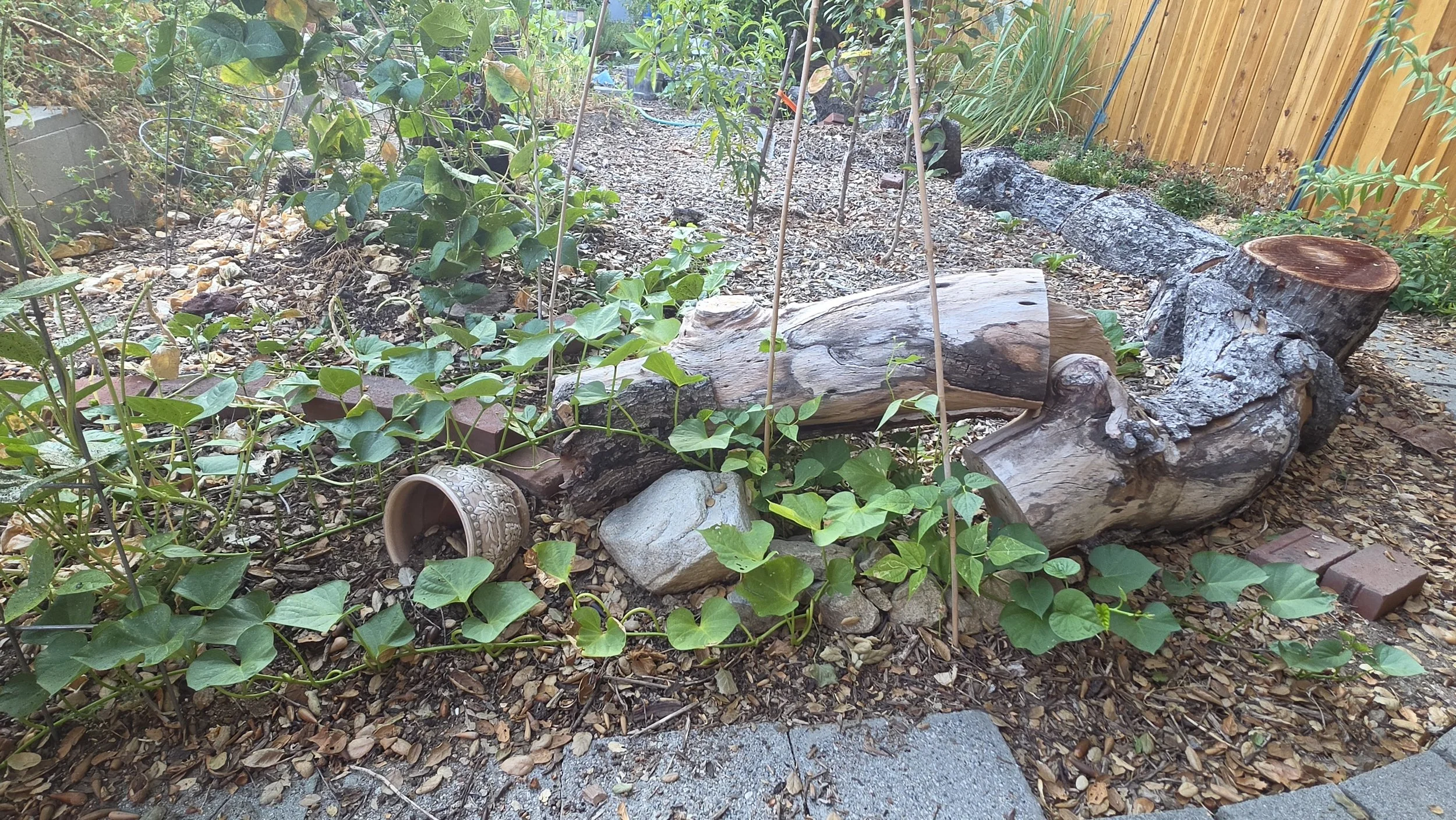
Take the avocado logs in my parents' garden, for example. You may have seen this spot before — I've shown it in past newsletters and on the livestreams. A sweet potato planted underneath has actually outgrown the ones in a bed that was built specifically for sweet potatoes. The soil here under the log is sandy and relatively unamended, which on paper makes it one of the worst spots I picked for this experiment. And yet it's the one doing the best.
I think the log has a lot to do with that. It hasn't broken down much yet, but its mass still shades the soil at different points in the day, and I've noticed the ground holds moisture noticeably better around it, especially where wood mulch has piled up against its side. There's mulch around the sweet potatoes I planted in other parts of the yard as well, without a log nearby, and those haven't grown nearly as large. Sun, shade, and other factors vary enough across the yard that this isn't a clean experiment, but the pattern has held up: the plants closest to the logs are consistently doing the best.
Given enough time, a log like this breaks down into humus — organic matter that holds water and slowly feeds the soil around it. A few logs placed around the garden can look good on their own, but they're not just decoration. They're doing real, ongoing work while they sit there.
One caution worth mentioning: not all wood belongs in the garden. Eucalyptus, for instance, is known to suppress the growth of some plants so I wouldn't use it to mulch vegetables, though it works well as a mulch in a pathway where you want to discourage weeds. Oak, pine, avocado, and most fruit-tree wood all make good nurse logs. And you don't need anything massive to get the benefit — smaller branches, bundled together or partially buried, do the same job of building habitat for fungi, bacteria, and beneficial insects, not just for plants.
If there's a section of your garden that isn't thriving, it might be worth trying a log or a bundle of branches there. Use it as a border, a shade source for something delicate, or just a decorative statement piece — any of those still builds the kind of microclimate that can help add valuable biodiversity to your garden. So the next time a tree comes down in your yard, or a neighbor's trimmings are headed for the curb, remember that it's not waste. It's habitat waiting to happen.
Thought of the Month: Phases of Life
A fallen branch isn't just decaying out there on the forest floor. Its role is shifting — from living wood into habitat, food, and shelter for everything that grows around and through it.
We go through our own version of that, more than once. We move from infant to toddler, spend a dozen-plus years in school, head into work or further study, and keep shifting from there. None of those stages is worth more than the others. The seed isn't more valuable than the seedling, the seedling isn't more valuable than the tree, and the tree isn't more valuable than the log it eventually becomes. Each one is performing important services for the system.
(And to be clear — I'm not saying you turn into a decaying log the day you retire. That's not the point I'm making here, haha.)
What I mean is that a garden doesn't function without the parts you rarely notice — fungi, bacteria, nematodes, protozoa — quietly doing the unglamorous work that keeps the whole system alive. A community works the same way. It needs teachers and grocery clerks, grandparents and farmers, builders and everyone in between. Pull any one of those roles out, and the whole thing gets weaker for it, even if nobody can quite say why.
That's the thought I kept coming back to this week: something can look unglamorous, or be easy to overlook, and still be essential to the system around it. Some of us feel like a seedling right now, some like the mighty tree, and some like a log on the forest floor — but every stage still has its part to play. So let's extend a little more patience and kindness to ourselves and those around us, whatever phase we're each in.
See you Monday evening for the livestream!
