A Garden Needs People
Welcome Back
Happy March! We're officially into the new semester, and things are starting to take shape - slowly but surely.
But growth, I've been reminded, depends on more than just good soil.
Here's what's in this week's newsletter:
This week I've got updates on class enrollment (including some urgent news), a peek at what's happening in each course this week, a garden update from my parents' backyard project, some reflections on what it really takes to keep a garden sustainable over time, and a thought of the week about something I've been mulling over a lot lately.
Thanks for being here - let's grow.
For Students
⚠️ Urgent: Two Classes Need Your Help
I want to be upfront with you all - two of my classes are currently at risk of being cancelled due to low enrollment, and I need your help spreading the word.
Tuesday 10:30 AM Regenerative Gardening
Palomares Park Community Center - Pomona
This class is dangerously low on students. If we can't bring more people in, this class may not continue.
Wednesday 3:00 PM Sustainability
San Dimas Senior Citizen Center
This class is also low - slightly better, but we still need roughly 10 more students to keep it running.
I haven't received official word yet on how long we have to build the numbers back up, so I'm hoping we have at least another week or two. I'll keep you posted as I learn more.
If you know anyone who might enjoy either of these classes - friends, family, neighbors, anyone - please tell them about it. I appreciate your support.
A Note on Attendance
The Friday 3:30 PM online Sustainability class is also borderline. I have enough people signed up, but only a handful showed up this week - and low attendance can put a class at risk just like low enrollment can.
I want to gently remind everyone: if you've signed up for a class, please do your best to show up.
I had a student who loved the class, stepped away for a bit, and came back mid-semester hoping to re-enroll - only to find the class had been cancelled because not enough people were attending. I don't share that to worry anyone, just as a reminder of why your presence matters, even in a free noncredit course.
Coming Up This Week
Regenerative Gardening (In-Person)
This week we're covering Your Garden in March - what to expect this month, what's happening in the garden right now, and a group discussion: what are your plans for your garden this month?
We'll also be going over gardening basics - key terms like annuals and perennials and other foundational vocabulary - so that students who are brand new to gardening have everything they need to feel confident.
If you don't have much gardening experience yet, this week's lecture is especially for you.
Sustainability Class (Week 2)
This week we begin Part 1 of the History of Environmental and Sustainability Movements.
We'll trace the development of modern Western environmentalism through five key figures:
Alexander von Humboldt
George Perkins Marsh
John Muir
Aldo Leopold
Rachel Carson
There may even be a sixth name added to the list by the time class rolls around - stay tuned.
Regenerative Gardening at the California Conservation Corps 🌿
I'm so glad to be back at the CCC, and I want to give a special welcome to all of the Conservation Corps students - if any of you find your way to this newsletter, welcome. We're really glad to have you.
This week we will hit the ground running with gardening basics and a planting demonstration (Courtney brought in some plants - thank you, Courtney).
We'll be walking the garden, talking through our composting system, dividing the garden into sections, and assigning each group their own plot to tend.
I'm also asking everyone to do some research before Week 3 on different types of animal barriers - ways to keep ground squirrels, rabbits, and other critters from getting to your plants. Each group will eventually build their own barrier for their plot.
I'll show you the kind I build, but I want to see what everyone comes up with.
For Online Students - New This Semester
I'm trying something new in Canvas this semester.
After each class session, I'll be using Zoom's built-in AI tools to create a recap - an outline of what we covered along with key takeaways - and I'll post it in the Discussion section.
My hope is that it becomes a space for ongoing conversation. If there was something you wanted to say during class but didn't get the chance to, or if something sparked a thought afterward, I'd love for you to share it there.
This is just for the online classes - in-person classes won't use this feature. Let's see if we can make the discussions come alive this semester.
In the Garden
Parents' Backyard Update - Part 2
This week was a slow one, and I'm okay with that. After being sick, I didn't have the energy to push hard - and honestly, I'm okay with that. I have to remind myself that I'm still recovering.
Here's where things stand.
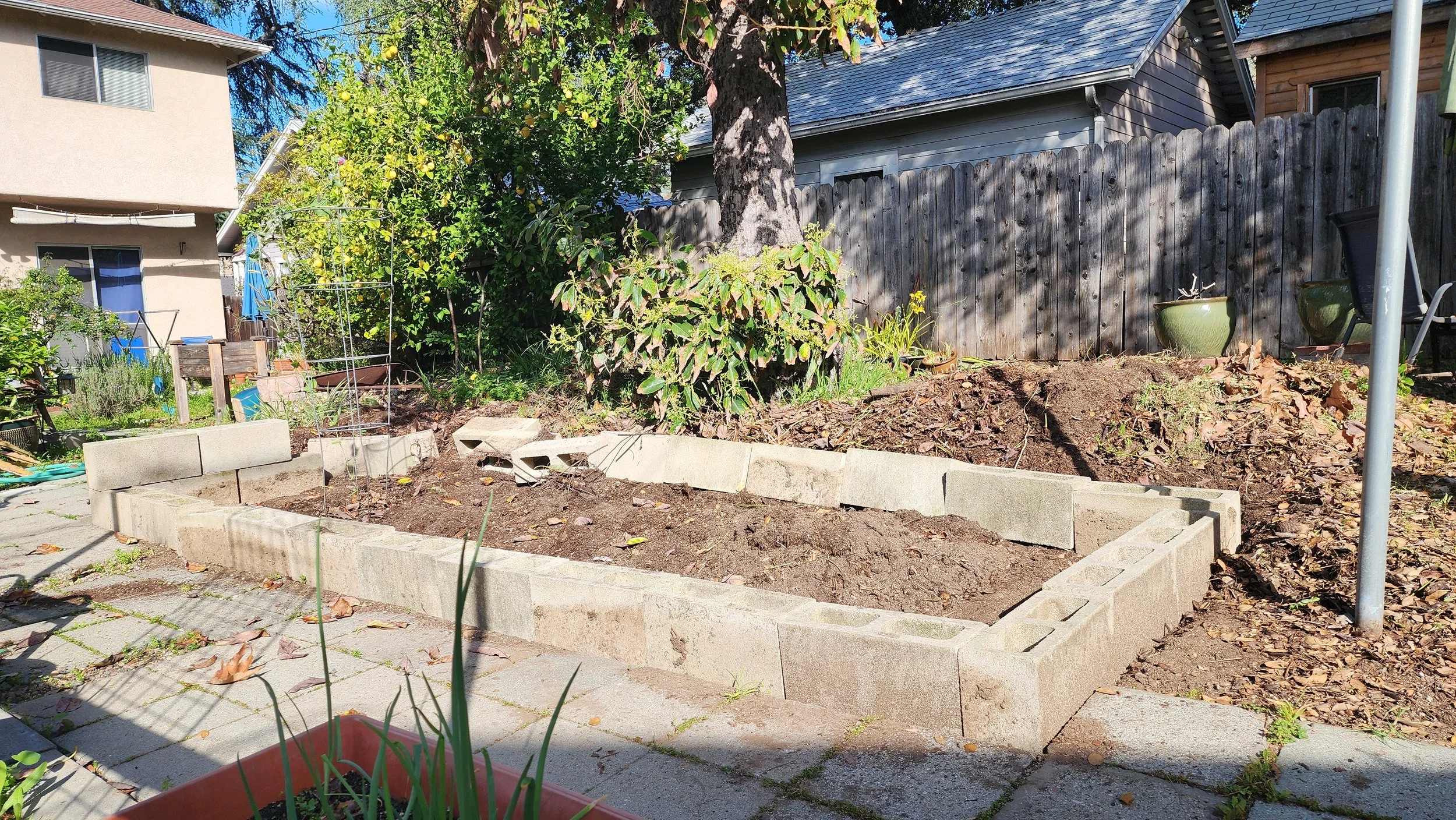
The first photo shows where we were earlier this week - not much further along from two weeks ago, honestly.
I raked back the avocado leaves, flattened the ground a bit, and laid out the blocks to get a general sense of placement.
Because I'm working on this in one or two hour stretches when I can, I'm skipping the guide strings that would normally make this job easier. With all the critters in the yard, I didn't want to mess around with that.
So I'm doing it the old-fashioned way - eyeballing the layout, checking level with a phone app (I use Bubble), and adjusting as I go.
I also know that once the avocado tree comes down in the coming weeks, I'll need to tweak the layout again. And down the road, as the roots decompose, there may be some settling.
But concrete block beds are incredibly durable - I've built several over the years, and when done right, they last a very long time.
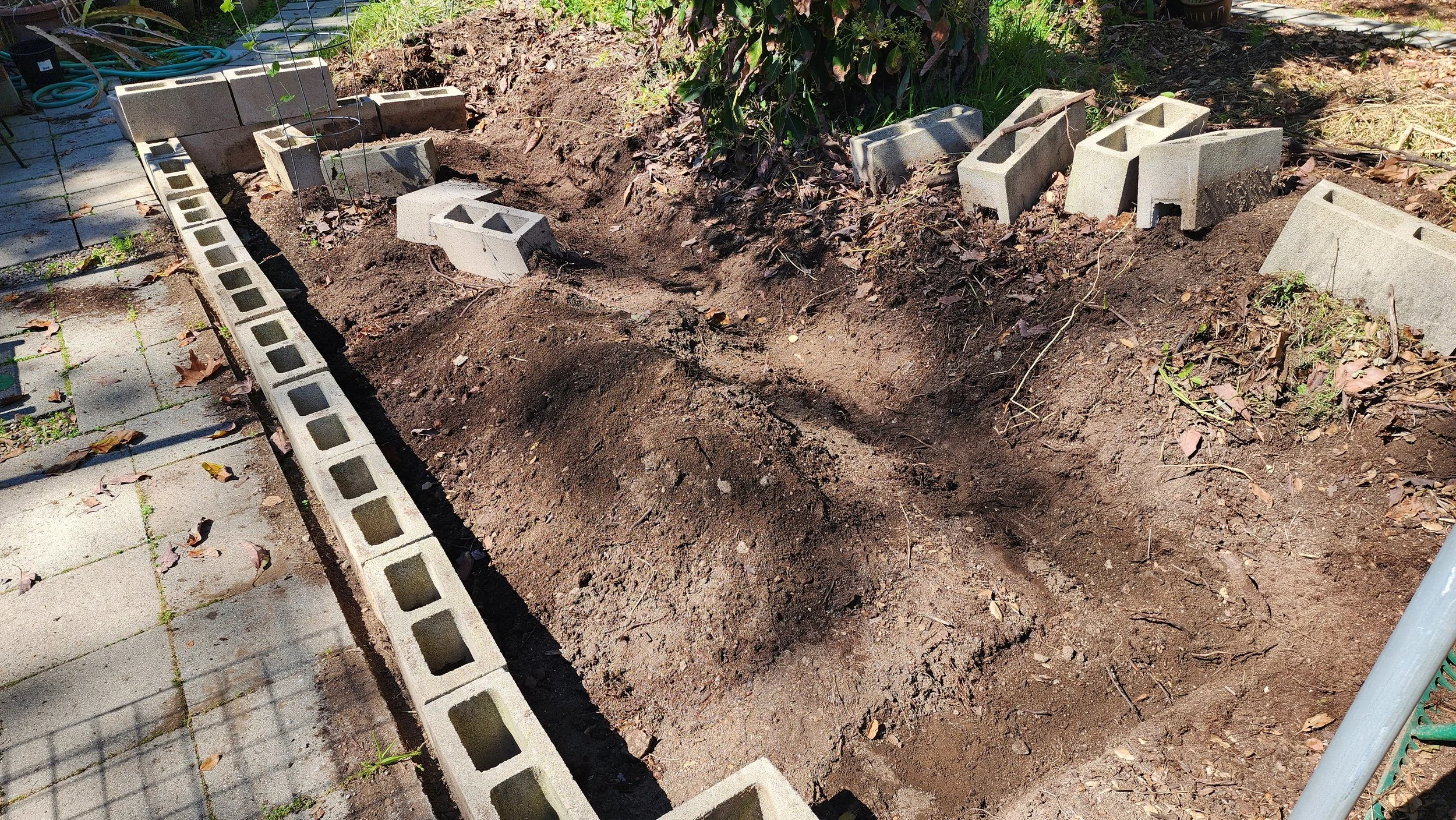
This shot is from this morning, and it tells the real story of what I was working through.
Once I started digging in earnest, I hit roots - a lot of them. That's expected near an established tree, but what surprised me was how many of them were dead and inactive.
It's hard to say exactly why. My suspicion is that the old pathways may have played a role, cutting off moisture and airflow to parts of the root system over time.
I also found some unexpected treasures buried in the leaf litter and soil: tennis balls, broken pots, old toys.
Some I recognized as my nephews'. Some I recognized as my own from when I was a kid.
It was a strange, sweet little time capsule - decades of a family yard compressed into the soil.
But it also gave me pause.
Many of these goodies were made of plastics and other materials I don't want anywhere near a food garden. Before I add any amendments or plant anything in this bed, I'm going to have to sift through the soil carefully to make sure nothing is leaching into what will eventually become a growing space.
It's a good reminder that even in a backyard garden, knowing what's in your soil matters.
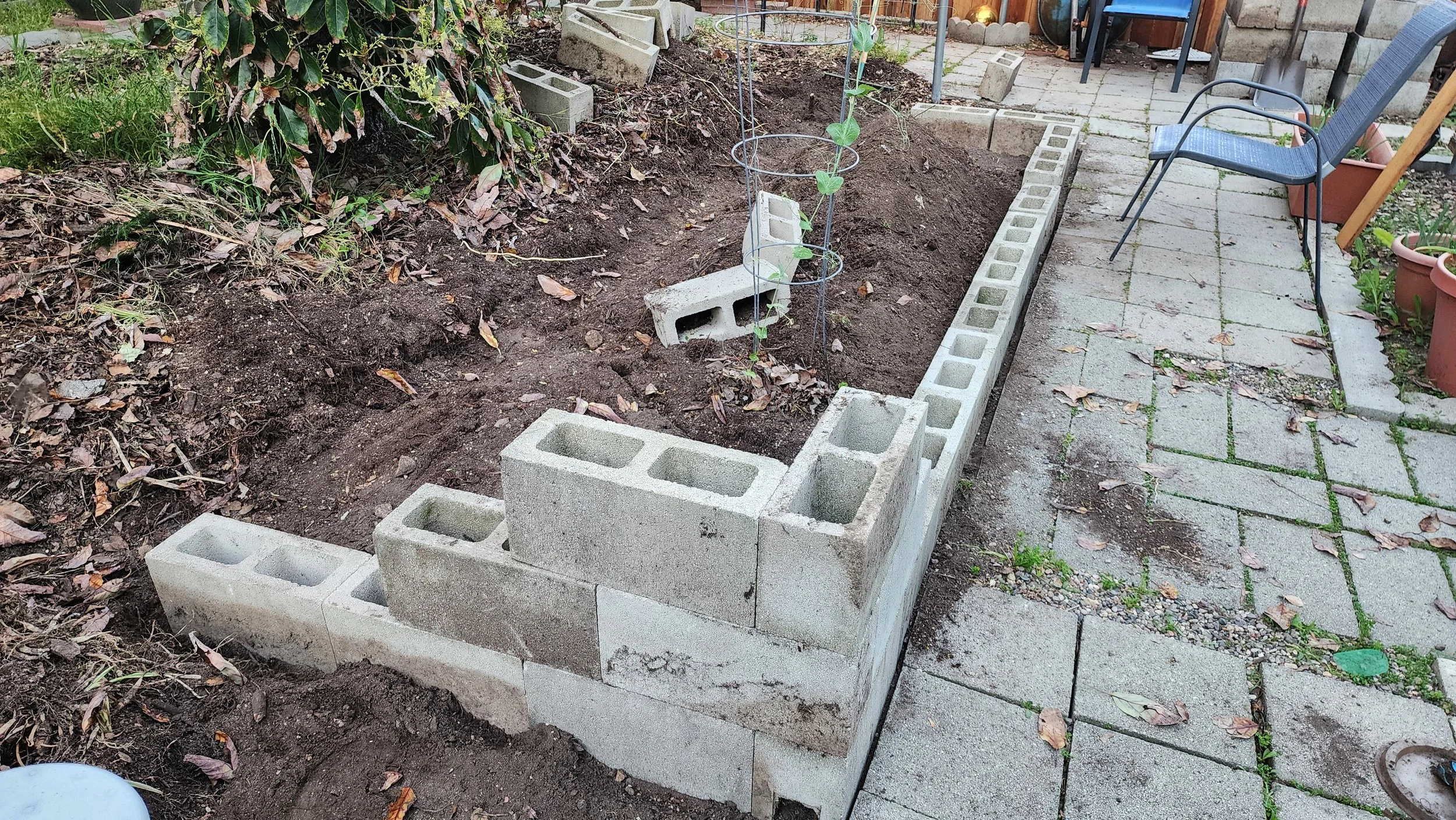
Here's the end of the day - the corner is complete, and I'm genuinely happy with how it's coming together.
I have just two more blocks to finish on the right side before I start on the east wall.
The north side is going to be the most challenging - the yard slopes from north to south, and the walking path has a slight east-to-west grade as well. Keeping everything level so the blocks sit flush and sturdy is slow, careful work.
The plan is to build this three blocks high, and I'm still deciding on the topper - either end caps to create a nice seating edge, or maybe wood planks.
I'm leaning toward leaving some of the holes open, though, because I actually want to create habitat for critters.
Some people think that's counterintuitive for a garden bed, but in my experience, the lizards and other small animals that move into those spaces do real pest control work.
I may also pack some leaves lightly into some of the holes to create a kind of carbon insulation - my theory is that it'll help keep the soil from heating up too much in the blocks. (Am I crazy? Maybe. But it makes sense to me, and I'm curious to see how it works.)
Saturday was the first real day I had to work on this all week, and even then I got pulled away a few times.
But I'll be out there Sunday, and hopefully Monday too. If I don't finish the bed this weekend, I have to finish it next weekend - I really want to get my parents' crops in the ground.
That said, we're still waiting on our arborist to give us a date for the tree removal, and I don't want to plant anything until after it's down.
More to come next week.
Living Sustainably
A Garden Needs People
Sustainability in the garden is often framed around soil health, water conservation, or carbon footprints.
But lately I've been thinking about a different kind of sustainability - the sustainability of the garden itself.
What does it actually take to keep a garden going, year after year, season after season?
I've come to believe the answer is people. Enough of them.
This has been on my mind as I return to teaching at the California Conservation Corps.
That garden has been through a lot. When I first started teaching there, we produced a meaningful amount of food together - it was exciting and tangible.
But the last couple of years have been harder. Classes ran for only a few weeks at a time.
Last year, our class was cut short in January because so many students were deployed to help with the fires in Pacific Palisades and Altadena (as well as the mud slides that followed). We were supposed to run through March. The garden had another empty season.
For a long stretch, there was really just one person at the Corps keeping that garden alive between classes - watering, tending, holding the whole thing together largely on their own.
That's a tremendous amount of weight for one person to carry. And I've seen what happens when the person carrying that weight eventually has to step away.
I saw it at Diamond Point Elementary when I was hired on to be their school garden coordinator. I've seen it in other school gardens.
Gardens that someone had poured real love and labor into - and when that person left, the garden often didn't survive. Sometimes the district stepped in to support it. Often they didn't.
I've watched a version of this play out at the Sustainability Garden at Mt. San Antonio College too.
Steve Williams built and nurtured that garden for many years. When he left, there were a lot of transitions - several different instructors in a fairly short span of time, myself included.
Every time I walk back through that garden, part of me wonders: is this place holding together?
But then I look around and I'm surprised. It looks good. It feels alive.
And I think I understand why - it's the students.
The people who keep coming back semester after semester because they genuinely love that space.
Steve mattered enormously. But somewhere along the way, the garden grew something beyond any single person. It grew a community.
That's what I want for the CCC garden.
That's part of why I'm genuinely encouraged that we now have a garden coordinator embedded in the program - someone who can be there even when the class isn't meeting.
It's not a perfect solution, but it's a meaningful step toward resilience: not one person keeping a garden alive by sheer will, but enough people that no single absence breaks the whole thing.
I think about this as a regenerative principle, honestly.
We talk a lot about building ecological resilience - diverse plantings, healthy soil, interconnected systems that don't collapse when one element fails.
Why would we approach the human side of our gardens any differently?
A garden needs people. Not one hero. People.
Thought of the Week
There Is No "Correct" Way to Garden
I've said this in many of my classes - and it's been on my mind all week - and I want to share it here.
There is no single correct way to garden.
I've seen people do everything "wrong" by the book - wrong spacing, wrong timing, wrong soil amendments - and end up with a breathtaking garden.
I've seen people follow every guideline precisely and watch every plant they touch slowly die.
Gardening is not a formula. It is a relationship.
Every garden is unique because it is the relationship between a gardener and a particular piece of land - and all the critters, insects, microbes, and weather patterns that come with it.
But community gardens take this idea even further.
They are the relationship between many gardeners and the land - and that multiplicity makes them rich, sometimes beautiful, and occasionally a source of headaches when different approaches bump up against each other.
What I want people to walk away with is this: your garden will look different from your neighbor's. Your methods will be your own. That's not a flaw. That's the nature of it.
But - and this matters - there is one thing none of us can do.
We cannot garden without nature.
I've seen gardens that rip everything out in pursuit of a clean slate, stripping the soil down to bare earth, eliminating every weed, every "pest," every uninvited guest - and then struggling to understand why nothing thrives.
The reason is that plants don't live in isolation.
They have relationships with other plants, with fungi in the soil, with insects and birds and the whole web of living things around them.
When we erase all of that in the name of control, we often erase the very conditions that make growth possible.
We are not at war with nature in our gardens.
We are guests in a living system - and the most successful gardeners I've known are the ones who learned to work with that system rather than against it.
They figured out how to be in relationship with their soil, their plants, their local critters.
They approached the garden with curiosity and care, not dominance.
There is no correct way to garden.
But there is a spirit that tends to lead to beautiful things: kindness, observation, patience, and a willingness to share the space.
Build that relationship - with the land, with the plants, with the creatures you're sharing it with - and the garden will meet you more than halfway.
Thank you for reading.
If you enjoyed this newsletter, share it with someone who might like it - and thank you for reading!
