The Garden as Medicine
Welcome to The Weekly Edition
What if the best thing you could do for your health this week was go outside and dig in the dirt? Not as a metaphor — as a literal prescription. Research on biophilia, nature deficit disorder, and the Japanese practice of shinrin-yoku all point to the same conclusion: time in nature heals us. And a well-designed garden doesn't just grow food — it grows the conditions for that healing to happen.
This week I spent a full day working at my parents' garden, and I came away with a new fruit tree update, a completed flower border, a south fence patio nook, two blueberries, and — somehow — a fully built and planted herb spiral that I did not plan on building. There is a lot to share. Read on for the full update, and don't miss Monday's Garden Office Hours livestream at 5:30 PM — this week we're covering herb spiral design and planting the grape vine live. You can join here: Garden Office Hour: Herb Spiral Design & Planting Grapes
For Students
Monday Livestream — Join Us!
As always, I'd love to see you at Monday's Garden Office Hours at 5:30 PM. This week we're planting the grape vine, pruning the fruit trees, and doing a full tour of the new herb spiral. Tune in here: Garden Office Hour: Herb Spiral Design & Planting Grapes
I'll also be posting a Facebook invite link on Monday — if you'd like to help me grow the livestream, please share it with anyone you think might enjoy it. Even if you can't attend yourself, sharing goes a long way. You can follow me on Facebook at facebook.com/GrowingWithProfessorBrown and share the link when it goes up Monday.
Week 8 — What to Expect in Class
Wednesday 10 AM — Important: Field Trip This Week
The Wednesday 10 AM class will not be meeting at the Diamond Bar Center this week — the center is closed. Instead, we are meeting at 10 AM at the California Conservation Corps for a garden tour. Please make sure you know the location and plan accordingly. See you there!
Regenerative Gardening (All Other Sections) — Week 8
This week we're diving into Regenerative Gardening Principle #4: Produce No Waste. We'll also be talking about what to expect in your garden during the month of April, and we'll have our monthly group discussion — come ready to share your plans for the garden this month. We'll wrap up with a composting lecture covering home composting methods, worm bins, and vermicomposting.
Friday 8 AM — Fundamentals of Sustainability (California Conservation Corps)
We had another great planting session last week and almost everything is looking strong. However, we spotted a gopher hole inside the garden for the first time — which is a first for us. If any corps members are reading this, please check on the squash mounds on Monday or Tuesday and contact me if any plants start disappearing. I want to get out there and address it before Friday if needed.
This Friday we'll be putting in a few more plants, and I have something special planned — so don't miss it. And a reminder: our class only runs for 9 weeks, which means after this Friday, there is only one class left. Make the most of these last two sessions!
Friday 1 PM — Fundamentals of Sustainability (Online)
This week we're covering Practical Applications of Sustainability, Part 1. We'll look at ways to reduce energy consumption at home, explore HVAC efficiency and sustainable heating and cooling practices, and examine how to minimize energy waste in everyday household systems. We'll also dig into hidden toxins in common household products and use the EWG database to assess the health and environmental impacts of products we may already be using. It's a practical, eye-opening class — come ready to look at your home a little differently.
In the Garden
Raised Bed Update
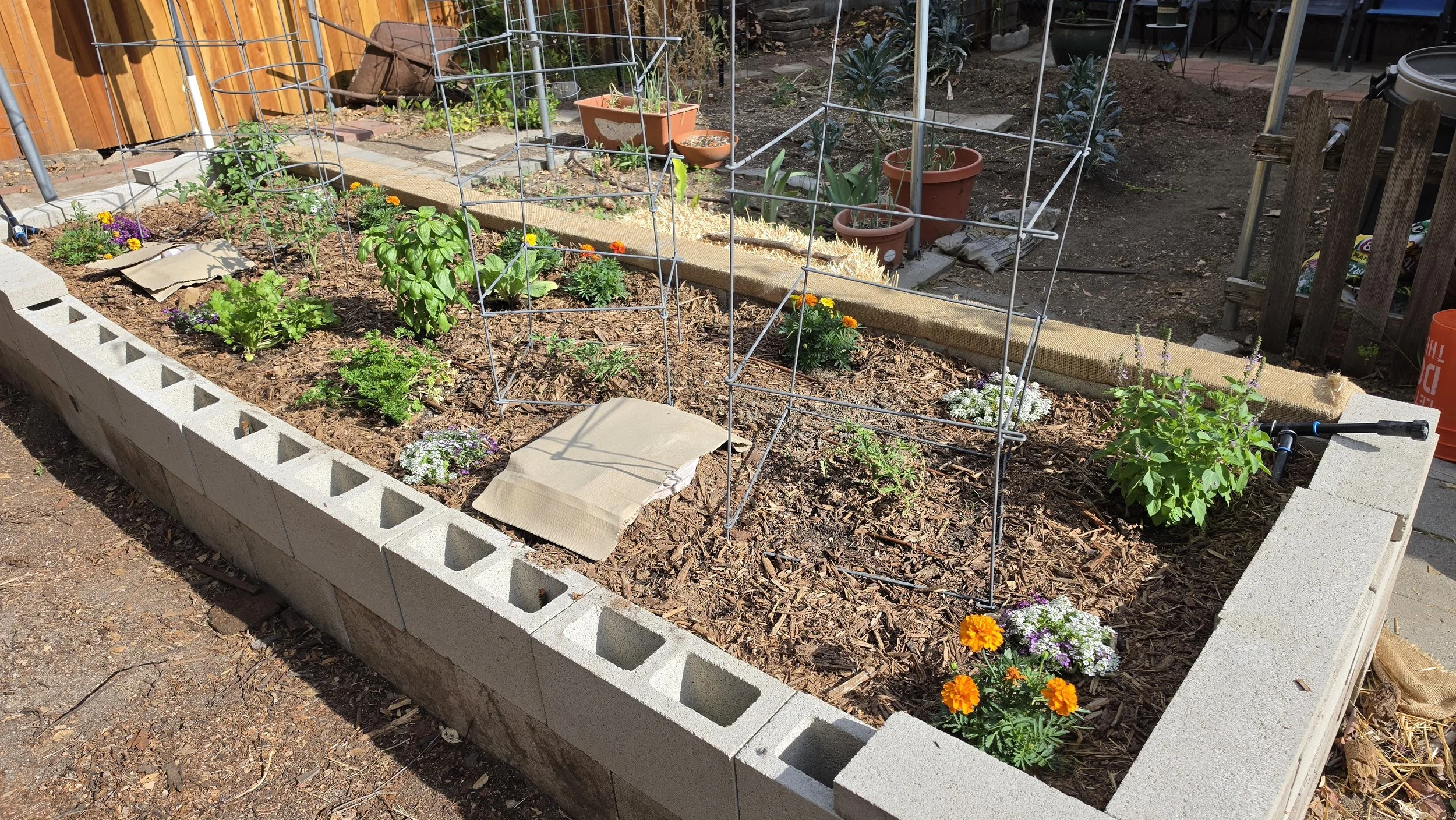
The hugelkultur raised bed is coming along steadily. I've been watering deeply twice a week to support the new plants, but I've also been giving it a little extra water on the off days to keep the wood chip mulch consistently moist — I have winecap mushroom spawn tucked in there that I'm trying to keep alive, and mushrooms need that ambient humidity to get established. The worm bin is going well too, though the worms are still getting settled. I've fed them a few times, but they're not eating a ton yet — that's completely normal when a bin is young and the population is still building.
As for the tomatoes: the Juliet and Sungold have more than doubled in size and are looking fantastic. The Cherokee Purple and Black Star, though, are struggling — they look a bit stunted, and I'm keeping a close eye on them. I'll give them another week or two, and if they don't start putting on growth, I'll likely replace them. Sometimes a plant just comes out of the nursery already behind, and there's no shame in starting fresh.
The Fruit Tree Trio — One Week In
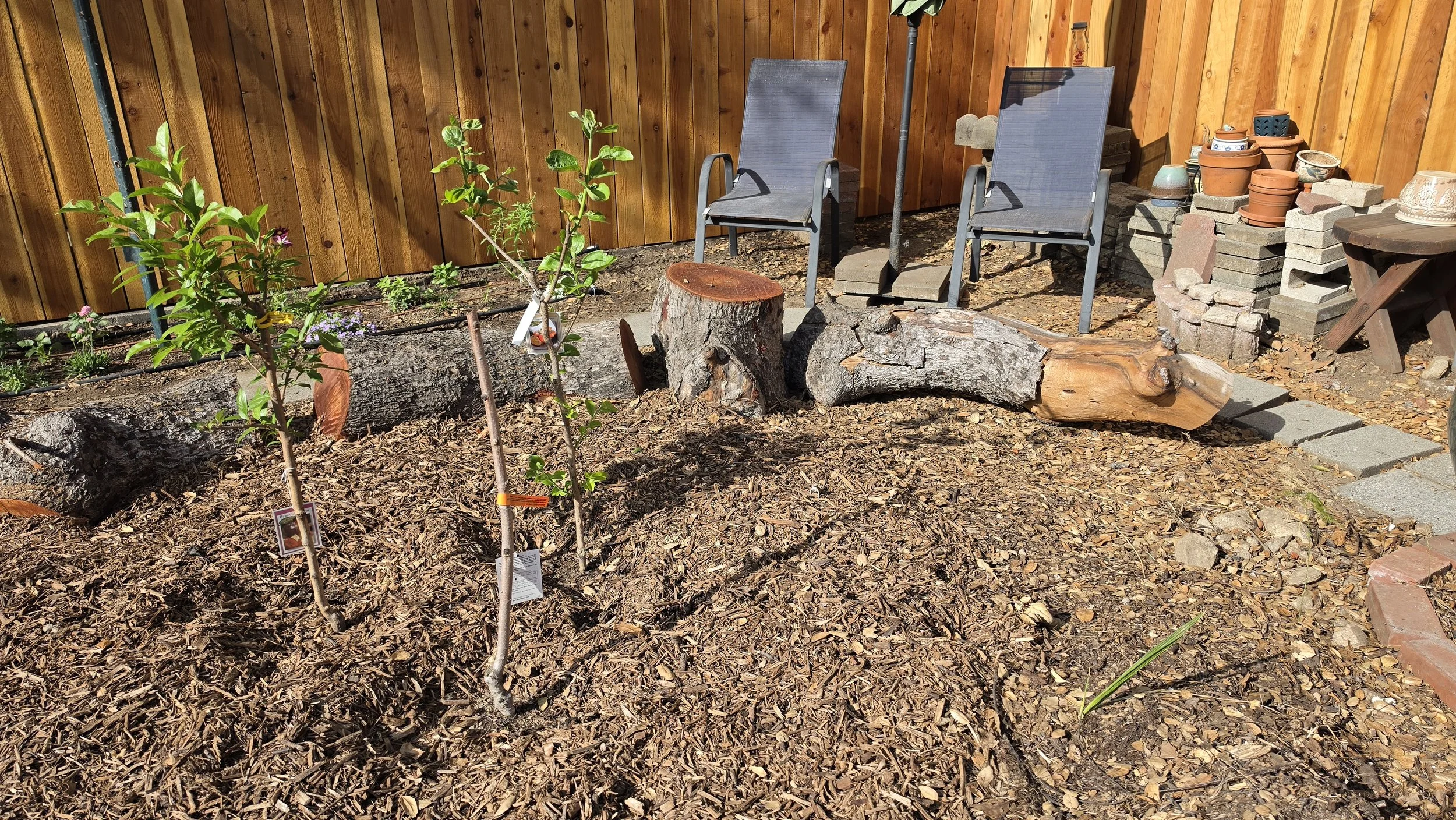
Fruit tree trio — Burgundy Plum, Mid-Pride Peach, Hachiya Persimmon
Last Monday I planted the third and final tree in this little fruit tree triangle — and I actually did it live during the Monday night livestream. All three trees are doing well. The peach was pruned way back at purchase, almost to nothing, but I can already feel the buds beginning to swell. After this weekend's rain I'm expecting to see some real movement there. The persimmon has a few dormant buds that have started pushing in the wrong places, so I need to go back in and make a couple of corrective cuts. And the plum still needs its first proper pruning — I'm planning to tackle both the persimmon and the plum during Monday's livestream so you can watch the process in real time.
You'll also notice the wood chips spread around the base of the trees. These are the same winecap mushroom-inoculated chips I used in the raised bed. I've been giving them an occasional light watering to help the spawn establish. As the trees mature and the area fills in, I'll back off the supplemental water — but right now I just want to give that mycelium every chance to take hold.
North Fence — A Flower Garden
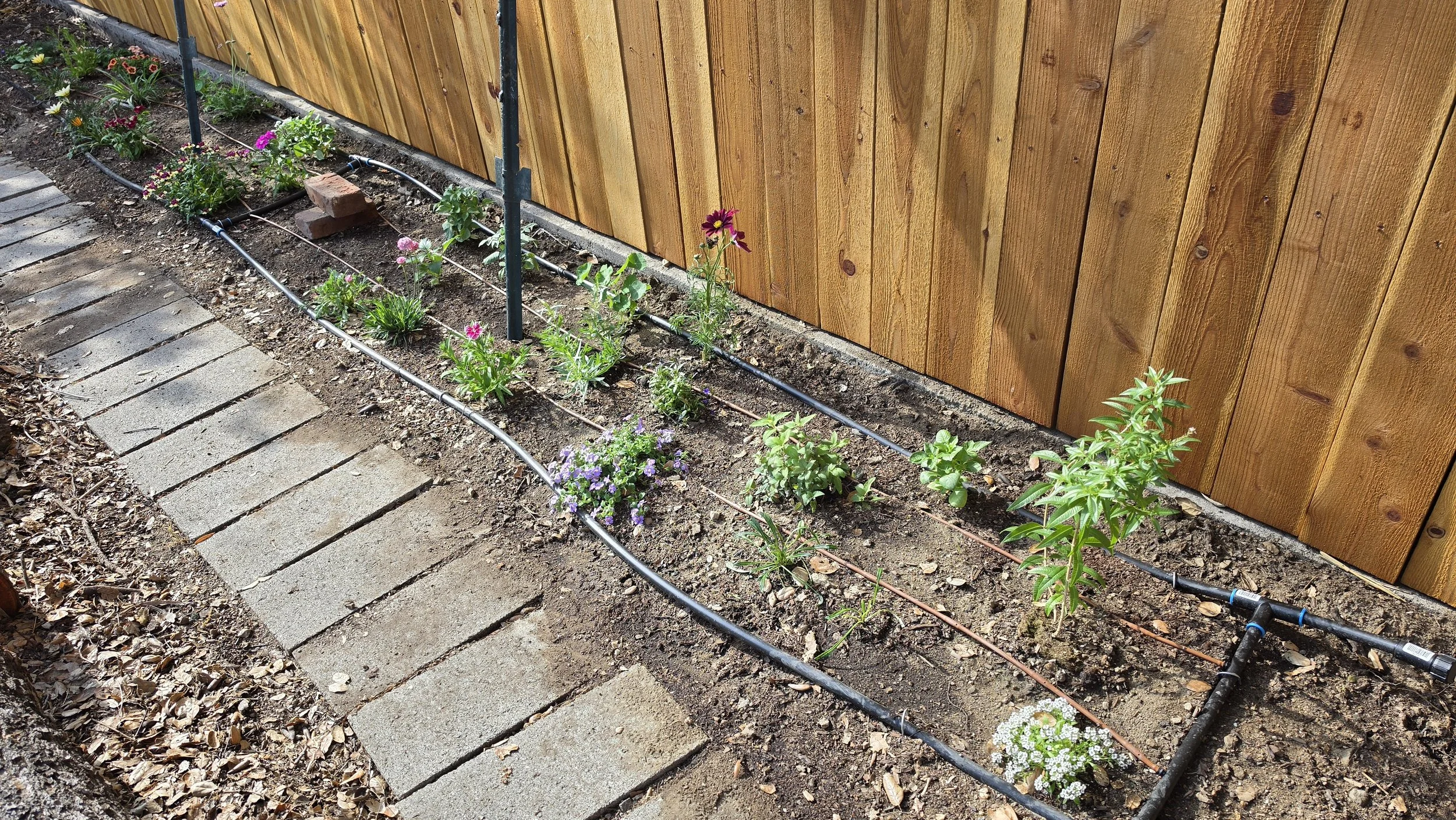
This bed runs along the north fence, just behind the fruit tree triangle. Originally I had planned to grow vegetables here — cucumbers on trellises, that kind of thing — but my mom had a different vision, and honestly, she was right. She wanted a flower garden, so that's what we planted. I picked up a mix of flowers and a few herbs, got the drip irrigation laid in, and now it's starting to come alive with color.
You can also spot two metal t-posts that haven't been pounded in yet — they will support the trellis for the blackberry that will go in right where those two red bricks are. I've already ordered it, and once it arrives I'll either plant it during a Monday livestream and build the arbor live, or turn it into its own dedicated video. The one thing I haven't done yet is mulch this bed — I want to put something down, I just haven't settled on what, so I'm holding off for now.
As for the grape I originally planned to plant here — that changed. After checking the sun exposure with the Sunseeker app, I realized this spot doesn't get enough direct light for a grape vine to thrive. So the grape is going elsewhere in the yard, and I'll actually be planting it live during Monday's livestream. I may even set up the trellis on camera, so tune in if you want to watch that process unfold.
South Fence — A Shade Garden Takes Shape
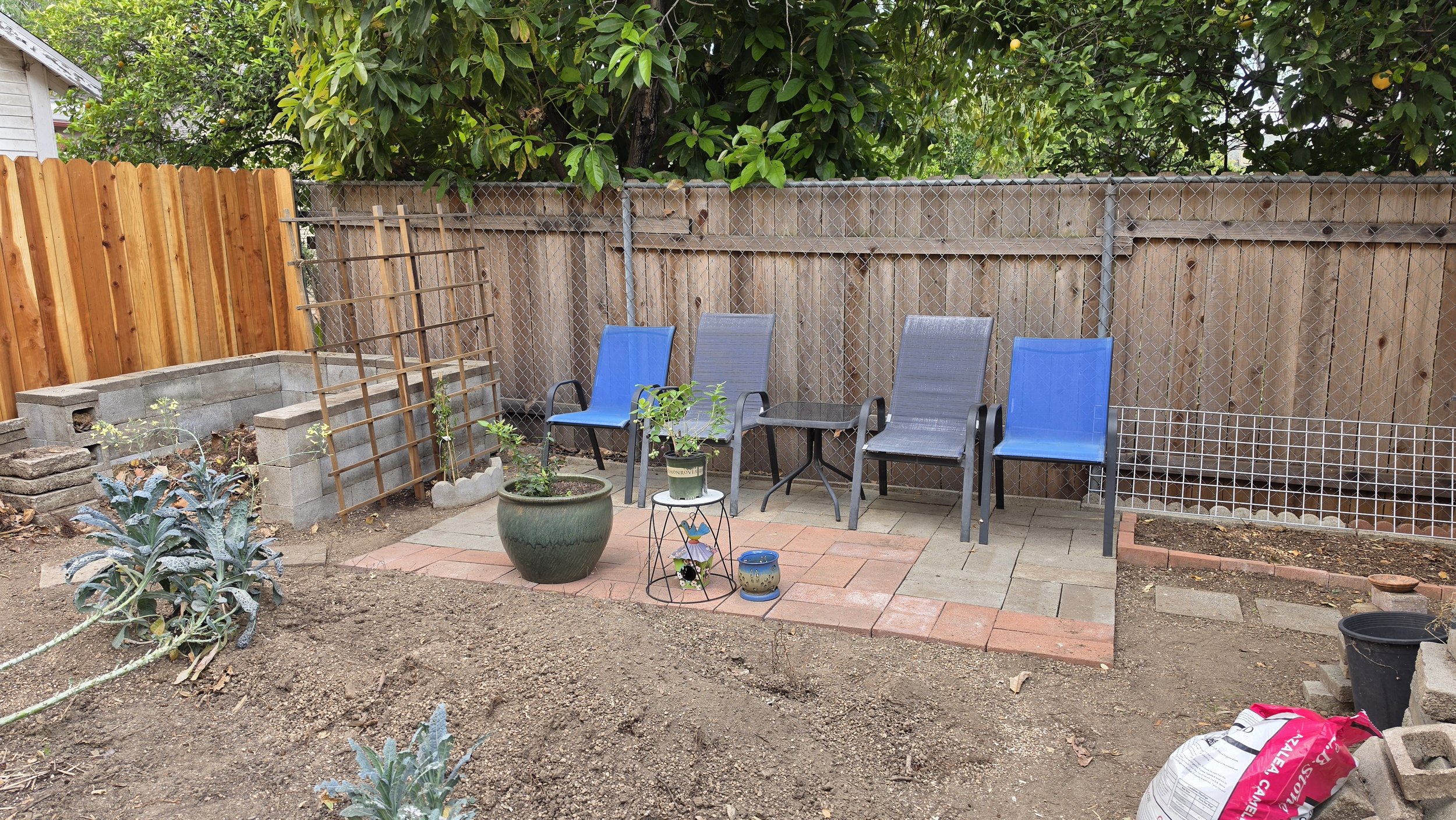
This is the south end of the yard — an area most of you haven't seen much of yet. This is where the original raised bed used to be, and if you've watched my tools video, you might recognize this fence as the backdrop. We removed that bed because the neighbor's trees have grown so large over the years that this corner just doesn't get enough sun for vegetables anymore. So rather than fight the shade, we leaned into it. My Mom set up a little patio seating area back here, and eventually this will become a proper shade garden — My Dad has a whole collection of shade-loving plants that will find their home in this spot.
Along the fence, you'll also spot a wooden arbor with a small plant at its base — that's a passion fruit, which we'll be training up the arbor and across the chain link fence to eventually create a living green wall. I've also ordered two Akebia vines (sometimes called chocolate vine) — a purple-flowered variety and a white-flowered one, both from Armstrong's. They're a really unique and underappreciated plant, and I'll be sharing more about them as soon as they arrive.
And yes — the blueberries are here too. One is already potted up, which I completed Saturday morning. The second one still needs its pot, and I'm saving that process for an upcoming video all about how to grow blueberries in containers — covering variety selection, soil mix, fertilizer, and how to make sure your plant actually flowers and fruits. Speaking of videos: I know it's been about a month since my last regular YouTube upload, but I have a backlog of content in editing right now and a whole wave of new videos coming in the weeks ahead. Stay tuned — there is a lot on the way.
The Herb Spiral — An Unplanned Day Project
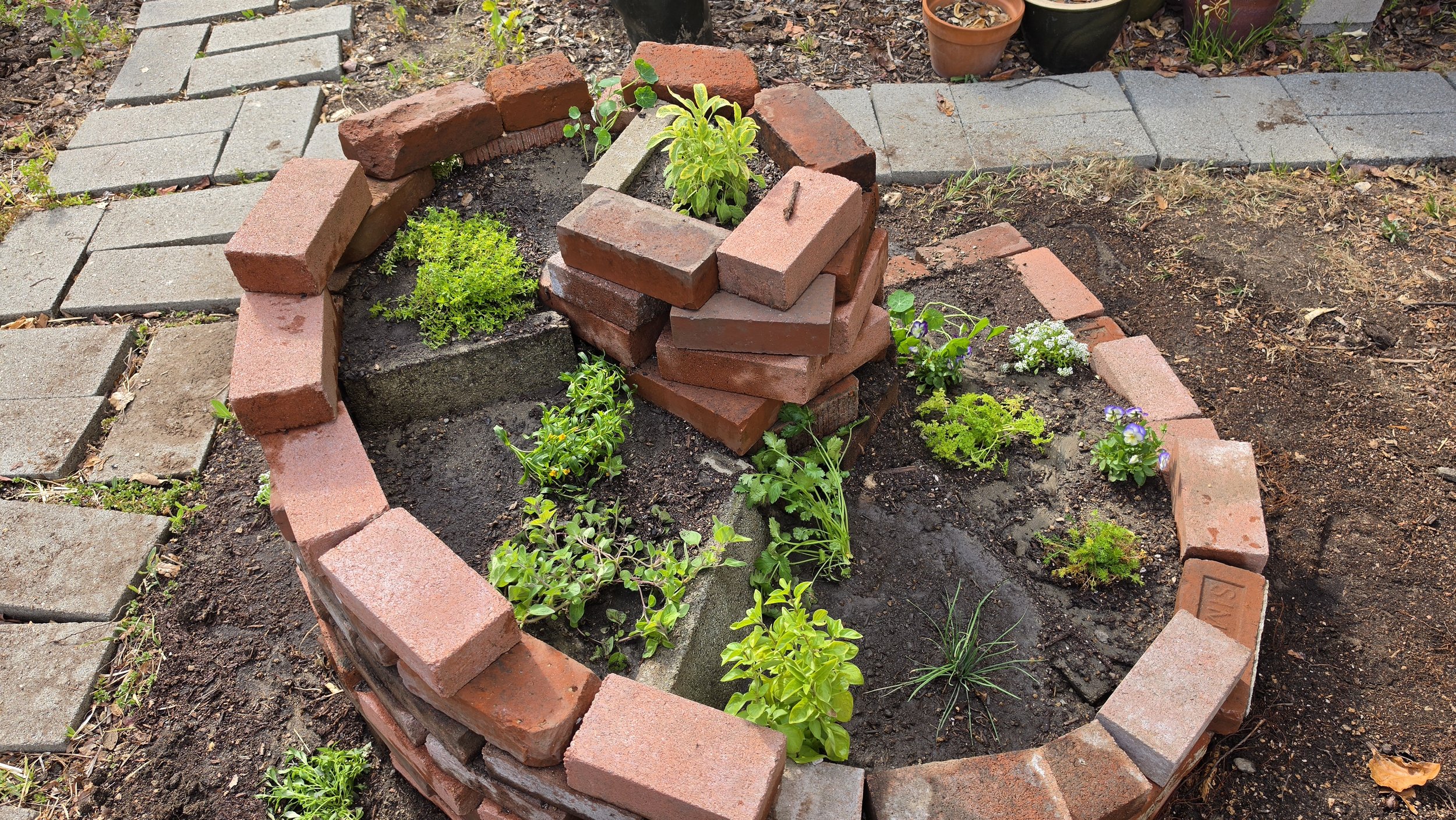
I have to be honest with you — this one was not in the plan for today. I've been thinking about building an herb spiral for a while, and I briefly mentioned it during last week's livestream. My intention this morning was simply to lay out the first course of bricks and get a sense of the shape. Eight hours later, I had a fully built, fully planted herb spiral. I got into the zone and genuinely could not stop. No regrets.
The structure is built from stacked bricks — no mortar — tapered slightly inward so they lean against each other and stay put. It feels surprisingly solid, though we'll see how it holds up over time. The real magic of an herb spiral is that the shape creates multiple microclimates within a very small footprint: the top is drier and gets the most sun, while the base retains more moisture and stays cooler — which means you can grow herbs with very different needs all in one compact structure. I'll be giving a full tour during Monday's livestream, and I also recorded the entire build process on my phone, so a complete how-to video is coming that will cover what an herb spiral is, how to orient it, how to build one, and which herbs go where. This is my first time building one — and I'm genuinely proud of how it turned out.
Sustainable Living — The Healing Power of Nature
Over the past two weeks in my Fundamentals of Sustainability class, we've been exploring something that I think is worth sharing with everyone: the science behind why spending time in nature makes us feel better — and what happens when we don't.
It starts with biophilia. The term was popularized by the naturalist and biologist E.O. Wilson, who argued that humans have an innate, evolutionary connection to the natural world. We didn't evolve in offices and subdivisions — we evolved in forests, grasslands, and gardens. Our nervous systems are tuned to respond to natural patterns, sounds, and textures in ways that built environments simply can't replicate. When we bring natural elements into our homes, cities, and workplaces — living walls, natural light, water features, wood and stone — we draw on that deep biological affinity to improve wellbeing, reduce stress, and even boost creativity.
The flip side of biophilia is what author Richard Louv calls nature deficit disorder. Louv, in his landmark book Last Child in the Woods, documented the growing disconnection between children (and adults) and the natural world — and the real psychological and physical costs that come with it. Rates of anxiety, depression, attention difficulties, and chronic stress have all risen alongside our retreat indoors. Louv's work helped spark a global conversation about what we lose when we lose contact with the living world.
One of the most compelling responses to that disconnection comes from Japan. In the 1980s, the Japanese government formally introduced the practice of shinrin-yoku — which translates roughly as "forest bathing" — as part of a national public health initiative. The idea is simple: walk slowly through a forest, breathe the air, take in the sights and sounds without agenda or destination. Decades of research have since shown measurable benefits including reduced cortisol levels, lower blood pressure, improved immune function, and significant reductions in anxiety and depression. Shinrin-yoku is now practiced around the world and has become the foundation of a growing field of nature therapy.
In class this week, we explored whether those benefits could translate to a virtual forest bathing experience. Students watched a guided forest therapy session followed by a silent walk through a beautiful woodland — and completed a short questionnaire before, during, and after. The results were striking: almost universally by the final questionnaire, students reported feeling better than when they started — just from watching and listening. Even a screen-mediated encounter with nature moved the needle.
Which brings me back to the garden. When I'm designing my parents' yard, I'm not just thinking about what to grow — I'm thinking about how the space feels to be in. The seating area tucked into the shade, the flower border my mom wanted, the herb spiral as a focal point you can walk up to and touch — these aren't decorations. They're invitations. An invitation to slow down, to notice, to stay a while. The best gardens aren't just productive. They're restorative. And that's a design choice you can make at any scale, even in a small backyard or on a balcony.
If the weather is improving where you are — and here in Southern California, it finally is — I'd encourage you to take it as a prescription. Go outside. Sit in the garden. Walk somewhere green. You don't need a forest. You just need to show up and pay attention.
Thought of the Week - The Garden as Medicine
We talk a lot about what a garden produces — the tomatoes, the herbs, the compost, the fruit. But I've been thinking lately about what a garden is, beyond its output. A garden is a place. And a place, designed with intention, can be medicine.
E.O. Wilson gave us the language for why: we are biologically wired to respond to living systems. Richard Louv gave us the diagnosis: most of us are spending too little time in them. And shinrin-yoku gave us the practice: slow down, go outside, and let nature do its work.
What I'm trying to build at my parents' house isn't just a productive garden. It's a place where people want to linger. Where you sit under the trees instead of walking past them. Where the spiral of bricks in the center of the yard draws you in to look more closely at what's growing. Where the shade corner with a couple of chairs becomes somewhere you actually spend a Sunday afternoon.
That's a design goal, not just a garden goal. And I think it's one worth holding onto: don't just ask what your garden can grow — ask what it can heal.
Thanks for spending a little time with me today. See you Monday.
