I Have No Idea If This Will Work
Welcome to The Weekly Edition
What does it look like when you try to put every principle of regenerative gardening into a single raised bed? Worm bins, winecap mushrooms, companion planting, drip irrigation, four tomato varieties, and a whole lot of hope — all sharing the same few square feet of soil. I genuinely don't know if it's going to work. But I can't wait to find out, and I can't wait to show you.
This week's newsletter is a big one. Field trip week is here for most classes, there's a lot happening in the garden, and Monday's livestream is coming up — I'm hoping to plant the first trio of fruit trees live on camera. Keep reading for all the details.
Join me live this Monday — watch and chat here. Sign into YouTube to use the chat — it works best on a computer.
For Students
Field trip week — know where you're going
URGENT CHANGE: Tuesday 1 PM Class Meeting Location
Attention Students:
Please note a last-minute change for our field trip tomorrow. Due to an issue at our original site, we are pivoting to a local gem to ensure we still get our hands-on time during our regular block.
New Location Details
Where: California Botanic Garden
Address: 1500 N College Ave, Claremont, CA 91711
When: Tuesday, April 7 at 1:00 PM (Normal class time)
Alternative Option
If you cannot make the Tuesday session or would prefer the Fairplex site, you are welcome to join the Wednesday morning cohort instead:
Where: Pomona Fairplex
When: Wednesday, April 8 at 10:00 AM
Instructions: View Fairplex Meeting Map & Details Here
I apologize for the last-minute change. Please text your classmates to help make sure everyone sees this before heading out tomorrow.
Looking forward to seeing you in Claremont!
Tuesday 1pm — Regenerative Gardening
The plan is still to meet at Lincoln Elementary in Pomona, but this has not yet been confirmed. I am waiting to hear back from the school and will be sending an email to the entire Tuesday class on Monday with the final confirmed location. Please watch for that email — it is important that you know where we are meeting before you head out.
Wednesday 10am — Both Wednesday Sections (including the 1pm class)
Both Wednesday sections will be meeting at 10am at the Pomona Fairgrounds Farm at Fairplex. The video below will show you exactly where to park and where to meet up. Either I or someone else will be there to direct you.
▶ Parking instructions — Pomona Fairgrounds Farm
⚠Please arrive before 10am. This is a guided tour led by the farm manager — right before the LA County Fair. Once the tour starts, we will be on the farm and no one will be available to direct latecomers in. If you arrive late, you may not be able to join. Please do not be late.
Thursday 1pm — Regenerative Gardening
Field trip to the California Conservation Corps at our usual time, 1pm. If you have never driven there before, it can be tricky to find. I've made a directions video starting from the Starbucks at the corner of Temple Ave and Pomona Blvd:
▶ Driving directions to the CCC
Important note: In the video I say "park anywhere along here," but that area is likely to be fully parked up by the time you arrive. We have a second parking area right next to the building we'll be visiting — just drive around until you see me. I will be standing near the street directing you in. The field trip starts at 1pm. Please arrive and be parked before then.
CCC Class
No field trip this week. We will meet in the garden as normal, check in on everything we've planted over the past two weeks, and the second group will be finishing up the last few plants still to go in the ground.
Online Regenerative Gardening
No formal field trip, but I'd love for each of you to individually visit a school or community garden in your area this week — community gardens especially. Take notes on how it's set up, what's working, and what could be improved. We'll discuss everyone's visits during class alongside the gardens I visited during the field trips.
Online Fundamentals of Sustainability
Another week of forest bathing. I wasn't able to record the in-person field trip I had planned (since the in-person class was cancelled), but we are continuing that conversation during our upcoming lecture. More to come.
Note - Diamond Bar Center is closed on April 15th
Please be aware that the Diamond Bar Center will be closed on April 15th. We will have a second round of field trips coming up — I'll have more information in next week's newsletter.
Community News
Free movie night at Santa Monica College
A student passed along something worth sharing — Santa Monica College is hosting a free community movie night on Wednesday, April 9th, starting at 5:30pm. You'll need to RSVP — click the link below and then click the link in their bio to sign up.
↗ Santa Monica College — Free Movie Night (RSVP via link in bio)
I'm going to try to make it, though I teach early on Friday morning so it'll depend on how the week goes. Events like this are a wonderful reminder that the sustainability and regenerative communities are out there, gathering, and doing things — and that we are part of something much bigger than any one classroom or garden.
In the Garden
The hugelkultur bed — finished, planted, and full of experiments
Monday livestream: Join me live this Monday at 5:30 pm — I'll be showing off everything that's been going on in the yard, working on a project or two, and wrapping up with chat time. Watch here. Make sure you're signed into YouTube to use the chat — it works most reliably on a computer. Just find the chat panel on the right side of the screen during the live broadcast, type your message, and hit enter. I'd love to hear from you.
And before I get into the garden update — a quick announcement. I know I said my next video was going to be about compost. I changed my mind. I have so much footage from the hugelkultur build that I got too excited and started putting together a video of the entire project. That is the next video coming to the channel — everything that went into building this bed, what's growing in it, and all the different systems at work. I can't wait to share it.
Now — let's talk about the bed itself.
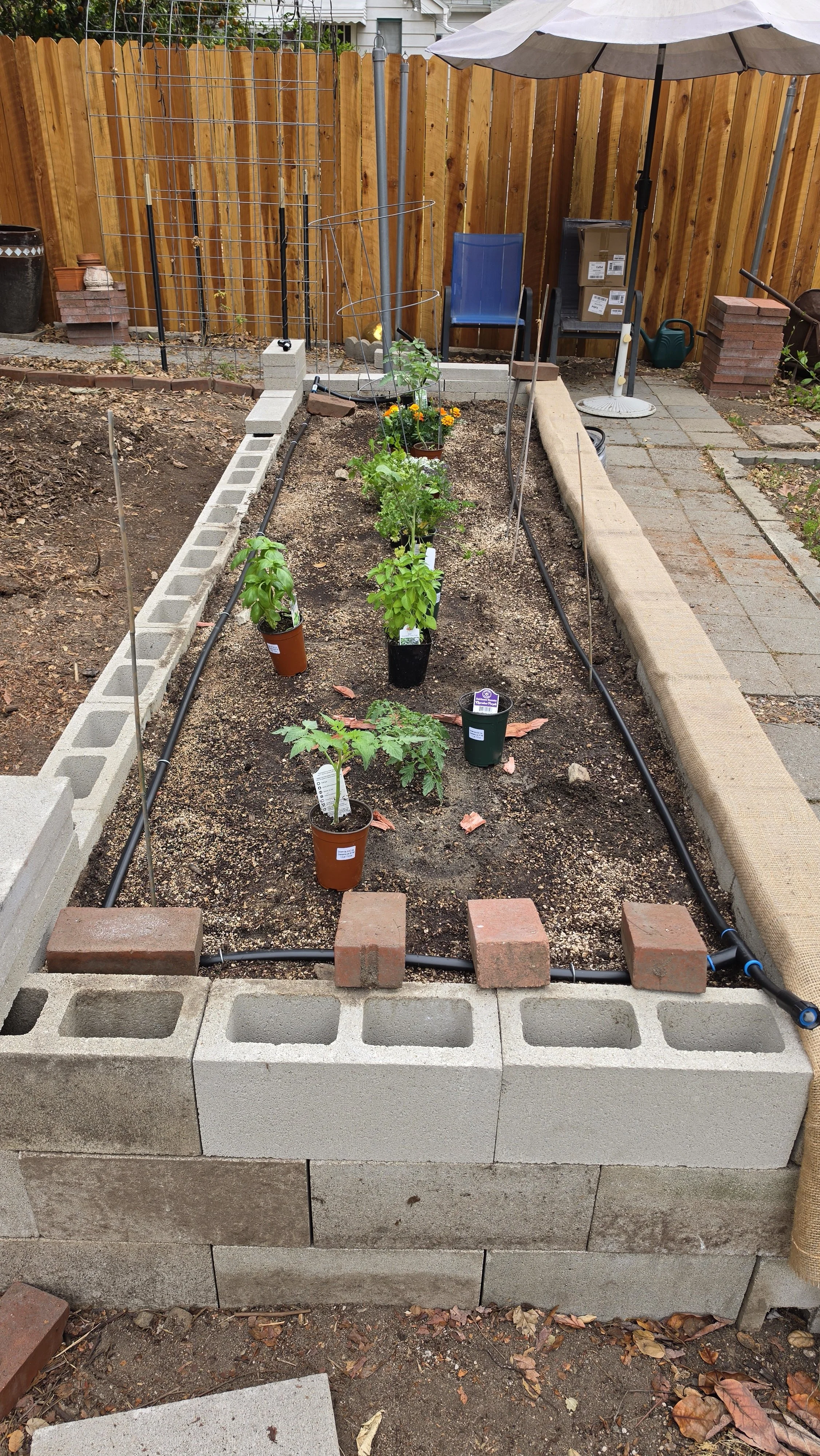
This is where we left off at the end of the Monday livestream. The bed was built, the outer irrigation was roughed in, and the plants were sitting in their pots ready to go. I came back the next morning to finish everything up.
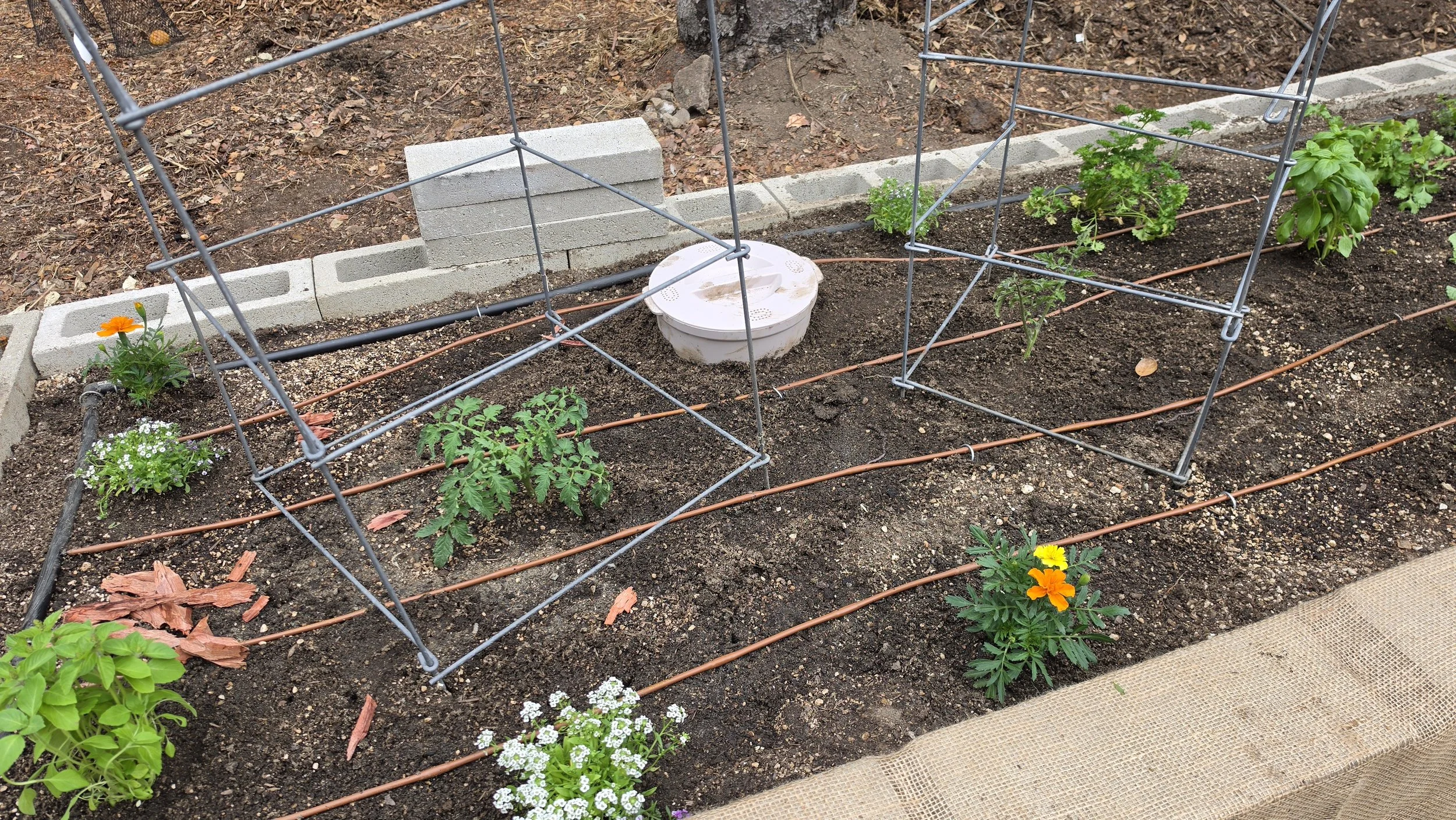
Here's the bed fully planted, before the wood chips went down. I wanted to show the irrigation layout while it was still visible. You'll notice the quarter-inch lines get a little wibbly-wobbly in places — that's actually one of the advantages of this type of tubing. It's flexible enough to work around obstacles, in this case the worm bins. I positioned emitters near the bins but not directly over them. I want to keep the surrounding soil moist so the worms stay comfortable, without dripping directly into the bin itself.
For companion planting, I gave each tomato plenty of breathing room and filled the spaces between with marigolds, alyssum, borage, cilantro, and parsley. I also scattered some carrot seeds — those haven't emerged yet as of this writing. We originally bought five tomato plants but decided to only put four in the raised bed. The fifth turned out to be a determinate variety — determinates fruit all at once and are done, which isn't what I'm going for in a hugelkultur bed — so that one is going into a pot. The four in the bed are a Sun Gold, a Juliette, a Purple Cherokee, and a Black Star. Very excited about all four.
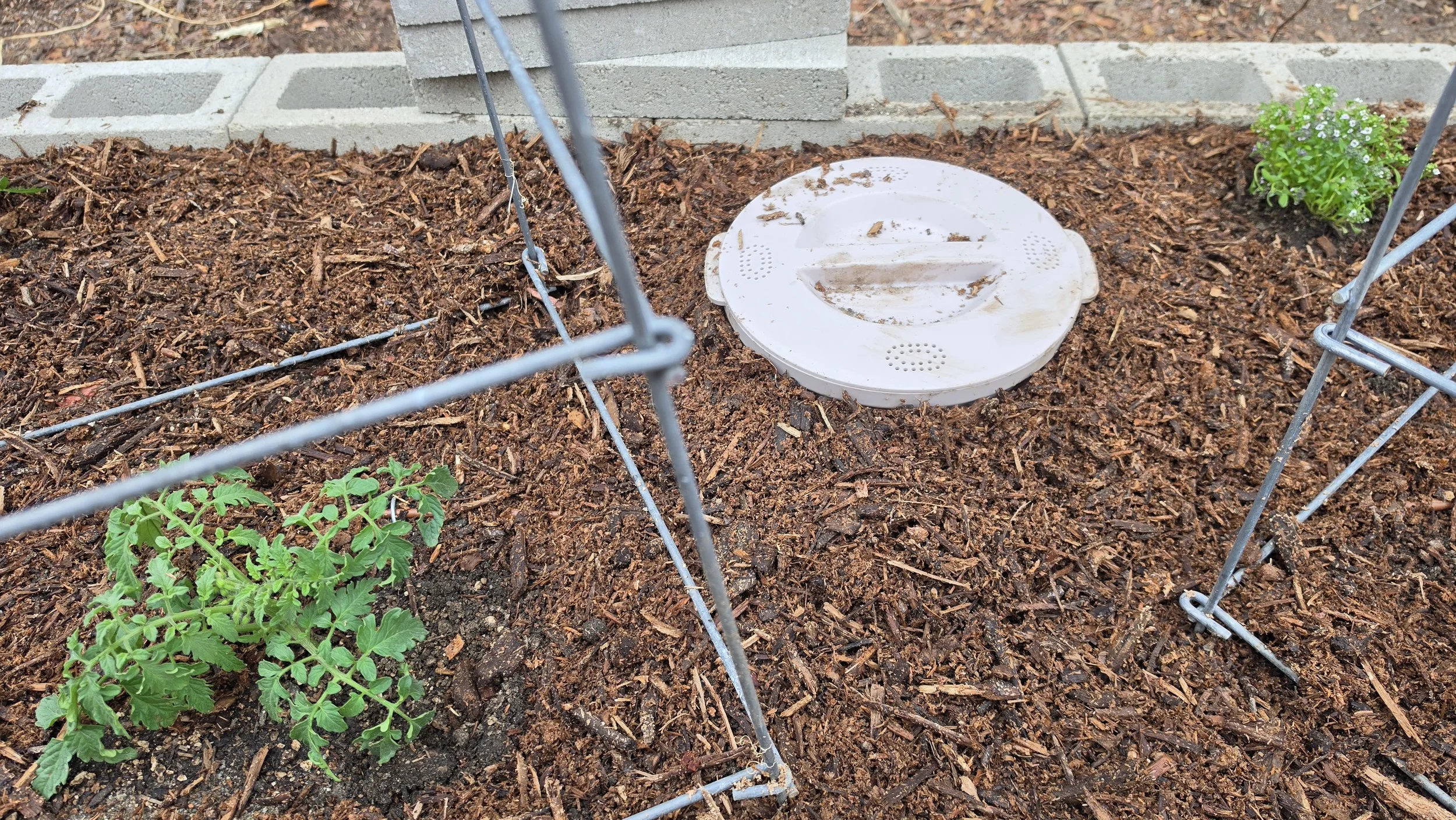
Here's a closer look at one of the worm bins after the wood chips went down. To get it started I used coconut coir, torn cardboard and paper as bedding, then added food scraps — greens, banana peels, a couple of blueberries. Then I went to Armstrong's and picked up the worms. I'll just say the price gave me a mild heart attack. But here we are.
Nestled between the worm bins is something I've been talking about in class and during the livestream — a winecap mushroom (Stropharia rugosoannulata) inoculation. Winecaps are a delicious edible mushroom, but what makes them particularly interesting for this bed is that their mycelium contains specialized cells capable of trapping and consuming nematodes.
When people hear "nematodes" they often think of them as pests to eliminate — and it's true that root-knot nematodes can cause serious damage to tomato roots. But nematodes are an enormously diverse group of organisms. There are nematodes that eat bacteria, nematodes that eat fungi, and nematodes that eat other nematodes. A healthy soil system should have nematodes — many different kinds — because they play a crucial role in keeping things in balance. We are never trying to wipe anything out of the garden. We are always trying to create conditions where different organisms keep each other in check.
So what I've built here is an experiment: tomatoes underplanted with companion flowers, inoculated with a mushroom known to help manage nematode pressure, watered by drip irrigation, and fed by worm castings from bins embedded directly in the bed. This is:
— Principle #1: Let Nature Do the Work
— Principle #2: Use Knowledge as Power
— Principle #3: Build Relationships
And honestly, if I went through all eight principles I think I could find every one of them represented somewhere in this bed. I want to be clear though: I have never tried this combination before. Nobody in my family has ever done anything like this in this yard. I genuinely don't know if it's going to work. But that's kind of the whole point — more on that below.
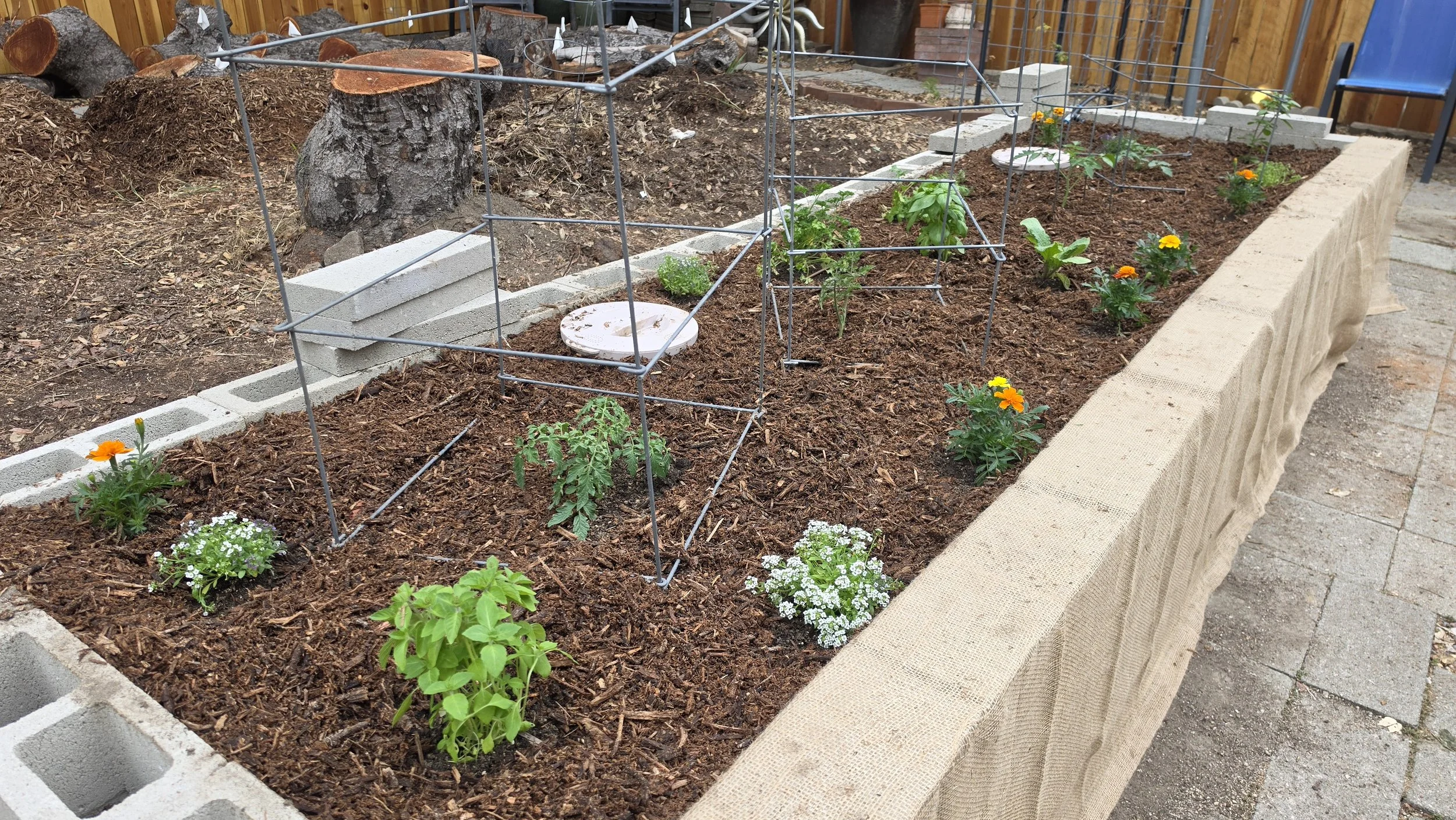
And here it is — finished. The wood chips are thick along the edges where I want to encourage the fungal culture to take hold. Under the tomatoes I kept it lighter to avoid smothering the carrot seeds. Once the carrots come up, I'll mulch more thickly around them, and eventually put down as thick a layer as I can across the whole bed.
You might notice the avocado stump in the background — and yes, the logs and branches from that tree are buried deep in the hugelkultur bed itself. But the wood chips you see on the surface are actually orchard chips from O. F. Wolfinbarger. Here's the thing about winecap mushrooms: they really prefer hardwood chips, and I wasn't able to get any. I honestly don't know whether prunus and other orchard species will work for getting this fungus established — I hope they do. To give it the best chance, I mixed in some hardwood sawdust as well, hoping that helps jump-start the mycelium. The mother pile is still going, and once the bed is fully topped off, the rest of those chips will be spread throughout the yard. The goal isn't just winecap mycelium in the tomato bed — it's to get it moving through the fruit tree guilds and eventually as much of this yard as possible. We'll see what happens.
Which brings me to Monday. If the third tree arrives from Armstrong's in time, I'll plant two before the stream and plant the third one live as a demonstration. I also have a grape vine for my dad, some herbs, and possibly some flowers to show off. Come hang out at 5:30 pm.
Thought of the Week
You don't have to have all the answers before you begin
Being regenerative isn't about being perfect. It's not about having the most foolproof plan, or knowing in advance that something is going to work.
The bed I described above is a genuine experiment. I have marigolds, alyssum, borage, worm bins, drip irrigation, winecap mushrooms, and four tomato varieties all sharing the same space — and I have absolutely no idea how all of those relationships are going to play out.
Regenerative gardening — and regenerative thinking more broadly — is about learning by doing. It's about being willing to try something, observe what happens, and adjust. It's about trusting that even when things don't go the way you expected, you will learn something worth knowing. And it's about finding real joy in that process rather than treating uncertainty as a problem to be solved before you can begin.
Half the fun of this, for me, is not knowing. I can't wait to find out.
Thanks for spending a little time with me today. See you Monday.
