The Work That Fills You
Welcome to the Weekly Edition,
I'm going to be honest with you — I am exhausted. Friday was an extra-long day of planting at the Conservation Corps — I worked from 5:30 AM to 5:30 PM, and then kept going on plans until nearly 10 PM. Saturday morning I was up at 6:30 and worked straight through until 5:30 in the evening hauling soil and woodchips. It is now Saturday night, I just sat down, and I am writing this newsletter on fumes. But I have a lot to share with you this week, and honestly? I'm too excited about what happened in the garden this weekend to not write about it. So grab your coffee, and let's get into it.
But before we get into it — two big announcements:
Live Stream Tomorrow (Monday) at 5:30 PM! After the great turnout on last week's live stream, I'm going live again. This time I'll be building the drip irrigation system for the raised bed and planting everything — tomatoes, basil, alyssum, marigolds, onions, garlic, and maybe even a few carrot seeds (a first for me around tomato plants). Come hang out, ask questions, and watch this garden come to life in real time.
No Class on Tuesday, March 31st. If you're in one of my Tuesday sections, enjoy the day off. We'll pick right back up the following week.
Now let's REALLY get into it.
For Students
Here's what's happening in your classes this week. Please read carefully — there are some important updates, especially about next week's field trips.
Regenerative Gardening (Week 6)
Topic: Soil Science
This week we're going underground. We'll be exploring soil ecology, food webs, mycorrhizal fungi, bioturbation, and nutrient cycling. We'll also touch on no-till and no-dig gardening practices.
Group Discussion:How do you treat your soil? Do you think of it as "dirt" — or as something alive?
⚠️ No class on Tuesday, March 31st.
Fundamentals of Sustainability (Friday Online — Week 6)
Topic: The Biophilia Hypothesis & Nature Deficit Disorder
We'll explore the concept of biophilia — the idea that humans have an innate connection to the living world — and examine how modern lifestyles contribute to nature deficit disorder. We'll also discuss the Japanese practice of shinrin-yoku (forest bathing) and what it can teach us about reconnecting with nature.
Conservation Corps (Friday 8 AM)
We're planting again this Friday! Last week we didn't get all of their plants in the ground, so we've got more to do. But it looks like it will be a nice cool day - perfect for finishing up this planting, finishing up all of the protective measures, and getting everything watered in!
CCC members — a special request: Please, please check on the plants on Monday. The rain that was in the forecast earlier this week is now looking unlikely, so the plants will need to be watered on Monday and Wednesday to survive. I'll also be reaching out to staff on Monday to coordinate watering, but I need your help too.
Looking Ahead: Week 7 — Field Trips!
This is not this week — this is next week. But I want everyone thinking about it now.
The in-person Regenerative Gardening sections will be going on field trips during Week 7. I'm still finalizing the details — I haven't heard back from one of the locations yet, and I'll be working that out on Monday. I will have all of the final information in next Sunday's newsletter, and I'll share what I can during class this week.
Please pay close attention to next week's newsletter so you know exactly where to go and what to do.
Online Regenerative Gardening students: Since the online section won't be going on a group field trip, I'm going to ask each of you to visit a school garden or community garden on your own — ideally during Week 7, though you're welcome to go this week if you'd like. Take notes on what you see: How is the garden structured? Is it the kind of garden you'd want to be involved with? Why or why not? During our online class that week, everyone will have a chance to share which gardens they visited, and then I'll spend the rest of our time talking about the field trips I went on, which gardens we saw, and my thoughts on each one.
Online Fundamentals of Sustainability students: I'll be honest — I'm adjusting my plan for Week 7. My original idea was to film the forest bathing field trip I had planned for the in-person section and share the video with the online class. Since the in-person section was cancelled this semester, that plan no longer works, and I'll admit I didn't realize it until this week. So I'll be putting together a new lesson plan during the week ahead. Rest assured — it's going to be a good one. I'll find something cool for us to do.
A Reminder for All Online Students
I've been doing something special this semester that I want to make sure everyone knows about. After each class session, I've been running the Zoom audio recordings through an AI summarizer that captures everything we discussed — key concepts, examples, discussions, all of it. These summaries are posted in the Discussions section of your course.
I'd encourage everyone to poke around in there. Find a class session that stood out to you, review the summary, and maybe post a comment reflecting on it. This isn't a homework assignment — but I think it's a great way to refresh and reconnect with the material. I'll be talking about this in class this week too.
In The Garden
Building an Ecosystem From the Ground Up
This weekend was one of the most physically demanding — and most rewarding — I've had in a long time. The goal: get the raised bed ready for planting and create the biological engine that's going to drive the whole system.
Let me walk you through it.
The Hügelkultur Foundation
If you've been following along, you know this raised bed isn't just a box of dirt. It started as a hügelkultur — a layered bed built on top of decomposing wood, branches, and organic material. The idea is that as this material breaks down over time, it acts like a sponge, holding moisture deep in the bed while slowly releasing nutrients.
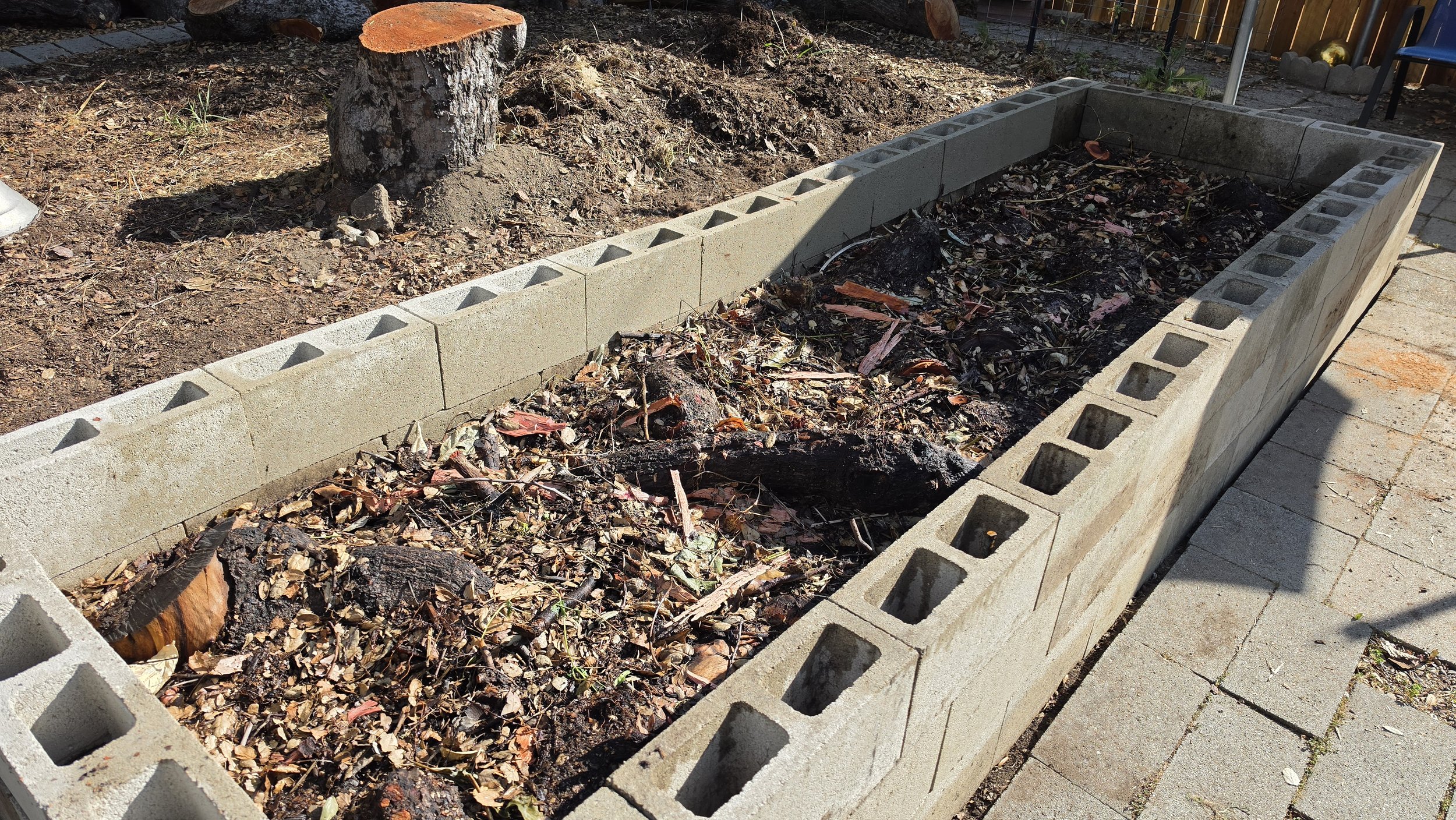
Here's what the bed looked like a few days ago, before I added the soil. You can see the layers of wood, branches, and organic debris packed into the cinder block frame. This is the foundation — the "skeleton" of the bed that will decompose slowly over the next several years, feeding the soil from below.
Filling the Bed
Saturday morning, I picked up a full cubic yard of veggie mix from O.F. Wolfinbarger Inc. in Chino. Hauled it home, and spent the afternoon filling the bed on top of the hügelkultur base. But before the soil went in, I added an entire bag of worm castings and a generous amount of used coffee grounds across the top of the hügelkultur material — one more layer of biology to kickstart decomposition and feed the microorganisms that will make this bed come alive.
Once the soil was in, I mixed in about half a box of mycorrhizal starter mix and scratched it into the top few inches. Then I gave the entire bed a deep, slow soak to make sure everything — from the soil surface all the way down through the wood layers — was fully hydrated. I still have more starter mix set aside to add directly into each planting hole when I put the plants in tomorrow during the live stream. The goal is to make sure every root has direct contact with beneficial bacteria and fungi right from the start.
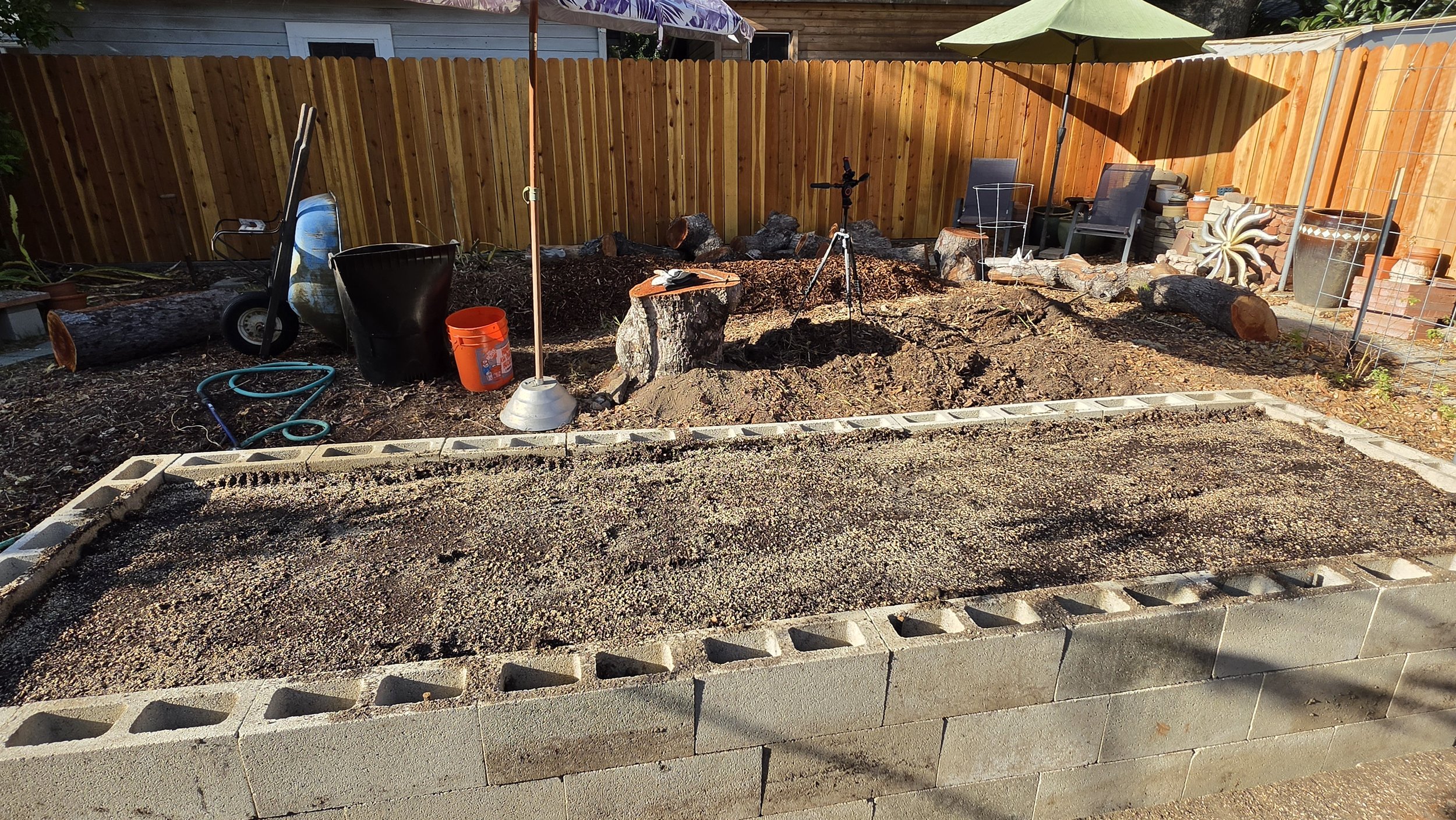
Here it is after the soil went in. It doesn't look like much yet — just a bed full of dark, rich soil. But underneath that surface is a whole world of decomposing wood, worm castings, coffee grounds, and mycorrhizal fungi getting to work. Tomorrow, this bed gets its plants.
The Wine Cap "Mother Pile"
This is the part I'm most excited about. After filling the raised bed, I went back to Wolfinbarger's for a full cubic yard of shredded orchard chips (Prunus species) and picked up five 20-pound bags of oak and hickory hardwood pellets. The mission: build a fungal "mother pile" — a massive inoculation bed for Wine Cap mushrooms (Stropharia rugosoannulata).
Wine Caps are remarkable organisms. They're aggressive decomposers of wood chips, and research has shown they can help suppress root-knot nematodes — a real problem for tomato growers. Since this is going to be a tomato bed, the Wine Caps aren't just a fun experiment. They're a deliberate part of the ecosystem I'm designing, working alongside the mycorrhizal fungi in the soil to keep the biology in balance. The mycorrhizae connect with the plant roots and help them access nutrients and water. The Wine Caps break down the woody mulch on the surface, recycling it into rich humus while keeping nematode populations in check. Together, they create a living system where the soil feeds the plants and the plants feed the soil.
Building the pile was a workout. I hydrated all 100 pounds of hardwood pellets by batch-expanding them in buckets — the compressed pellets puff up into fluffy sawdust when you add water. Then I layered everything: oak leaves on the ground as a natural "breathing floor" for airflow, then alternating layers of orchard chips, hydrated sawdust, and Wine Cap spawn — several layers deep, like a mushroom lasagna. I'd originally planned a volcano-shaped "caldera" mound to maximize airflow, but ended up building a long, low pile instead, which worked even better for the space. Once it was all built, I soaked the entire pile deeply to make sure the mycelium had the moisture it needed to start colonizing.
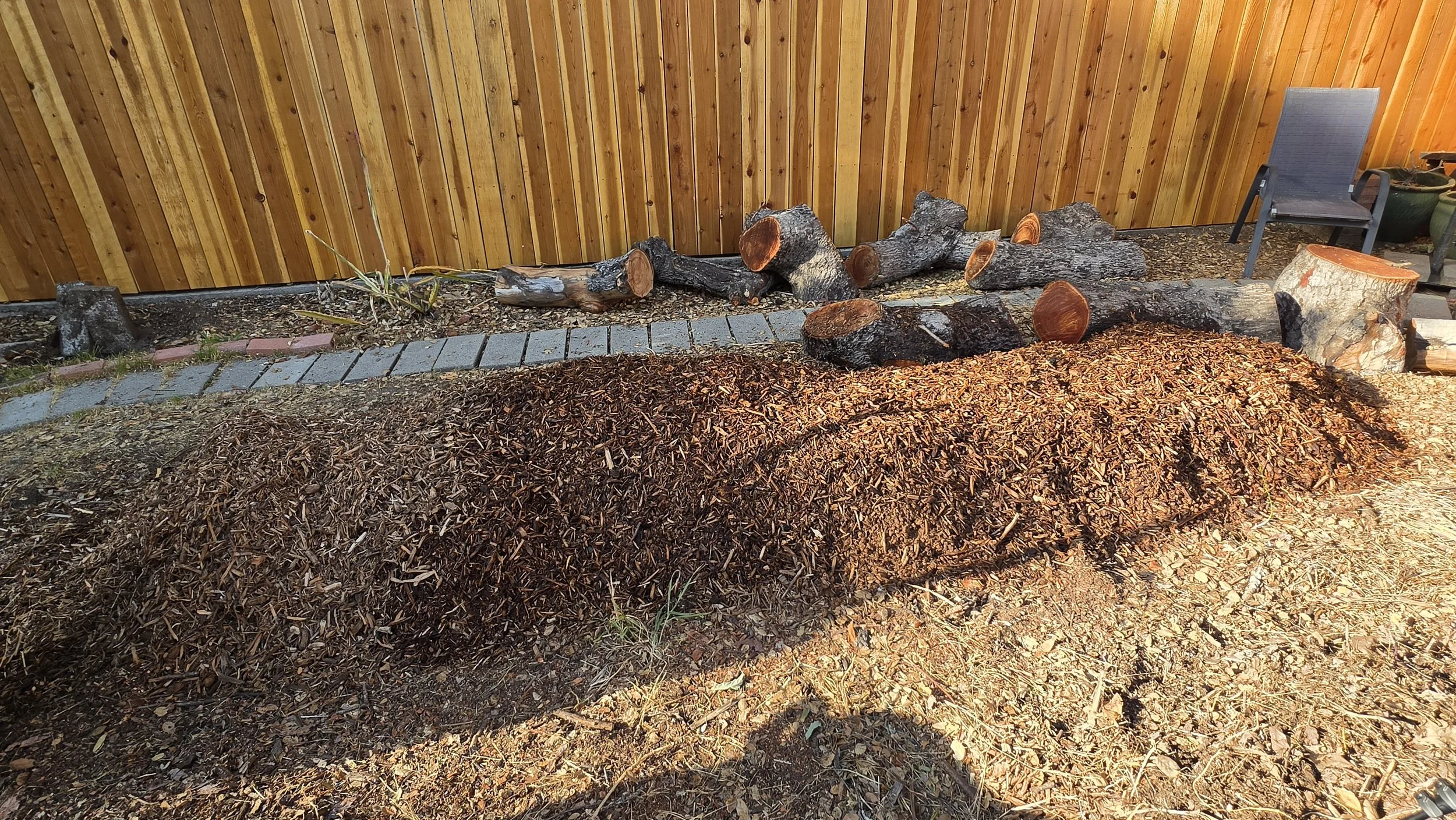
Here's the mother pile, tucked along the fence line with the old avocado logs behind it. The plan is to let the mycelium colonize this pile over the coming weeks, and then spread the inoculated chips into the raised bed and the orchard area. Essentially, this pile is a nursery for the fungal network that will eventually run through the whole garden.
The Experiment
I want to be transparent about something: I have never built a system this complex. Hügelkultur, mycorrhizal inoculation, Wine Cap mushroom cultivation, companion planting, drip irrigation — all layered together in a single bed. I honestly don't know exactly how it's going to turn out. This is an experiment. But it's an experiment grounded in ecological principles — every element has a purpose, and they're all designed to support each other.
That's what makes it so exciting. This isn't just a garden bed. It's an attempt to build a small, functioning ecosystem. And tomorrow, it gets its first plants.
Don't miss the live stream — Monday at 5:30 PM. I'll be installing the drip irrigation and planting the full companion polyculture: tomatoes, basil, alyssum, marigolds, onions, garlic, and maybe some carrots. Come watch, ask questions, and see this ecosystem take its first breath.
Thought of the Week
I've been thinking about why I'm so tired and yet so energized at the same time.
These have been genuinely long days. My body is sore. I'm writing this newsletter at 8 PM on a Saturday night after two days of hauling soil and woodchips and building things in the sun. By any reasonable measure, I should be completely spent.
And I am. But I also feel alive in a way that sitting at a desk never quite manages.
I think the difference is that this project isn't for me. I mean, yes, I get to geek out about mycorrhizae and mushroom spawn and hügelkultur — and I love that. But the reason I'm building this garden is for my parents. And there is something about doing hard work for the people you love that changes the nature of the exhaustion. It stops being draining and starts being filling.
I think a lot of us are walking around looking for something to feel passionate about. And I wonder sometimes if the search itself is what keeps us stuck — because we're looking inward when the answer might be outward. Some of the most alive I've ever felt has been when I was doing something for someone else. For family. For friends. For students. Sometimes even for complete strangers.
I forget this all the time. I get caught up in my own work, my own plans, my own stress. And then a project like this comes along — hauling a cubic yard of soil for my parents' garden on a Saturday morning — and I remember.
If you're looking for something that makes you feel energized, try looking around instead of inward. Find someone who could use a hand. Build something for someone you love. You might be surprised how much it gives back.
