When Nature Speaks, We Should Listen
Welcome to the Weekly Edition
⚠️ IMPORTANT: Monday's livestream "unofficial office hour" has been moved to 5:30 PM. Join the livestream here.
Welcome back to Growing with Professor Brown. This has been a wild week — record-shattering heat across Southern California, planting plans delayed, and nature reminding us who's really in charge. I'll have more to say about that in this week's Thought of the Week.
Before we get into it, I have to share a milestone I still can't quite believe. My recent YouTube Short, "Self Watering Pot Hack - Easy Plant Care!", has taken off in a way I never expected. As I write this, it has crossed 38,000 views and is still climbing. I honestly have no idea what made it catch fire, but I want to sincerely thank everyone who continues to watch, share, and support the channel. It means more than you know.
A few quick notes for students: field trip forms are coming — I'll have them in class this week, so be ready to fill those out. I'm still waiting to hear back from a couple of locations and will have a full update during class. Also, I'll be sharing a yard update and other announcements during Monday's livestream, so join us at the new time: 5:30 PM on Monday. Think of it as an unofficial office hour — come hang out, ask questions, and catch up.
Now let's get into it.
For Students
Regenerative Gardening — Mt. SAC
This week's topic: Regenerative Gardening Principle #3 — Build Relationships
Lecture focus: Introduction to garden ecology and holistic garden health, with an emphasis on biodiversity and ecological relationships in the garden
Sustainable gardening practices covered: Polyculture, companion planting, and crop rotation
Group discussion: Discuss the relationships you hold dear and how they parallel relationships in the garden
Regenerative Gardening — California Conservation Corps (Friday)
Last week's planting was postponed again due to the extreme heat wave. This Friday, we plant.
The weather outlook is in our favor — temperatures are expected to drop back into the 80s after our planting day, with 70s the following week. We may even get some rain, which is perfect timing for getting new plants established.
Come prepared: Bring gloves and be ready to get your hands in the soil.
Attendance is critical this Friday. We need at least one representative from each group to ensure every section gets planted. If a group has no one present, their section will not be planted.
Fundamentals of Sustainability — Online
This week's topic: Economics — past and current economic models
Key concept: The difference between linear and circular economies
We'll watch:The Story of Stuff, along with additional videos exploring how circular economies are emerging in different parts of the world
Discussion: How we can move toward circular economic models in our own lives and communities
Upcoming — All Students
Field trip forms will be distributed in class this week. Be ready to fill yours out. I'm still waiting to hear back from a couple of locations, but I'll share a full update during class.
Monday's Livestream — 5:30 PM — The time has moved partly to beat the heat, and partly because I have a faculty meeting earlier that afternoon. This is your unofficial office hour — come with questions, thoughts, or just hang out. I'll have an update on the yard and a few other things to share. Join the livestream here.
Living Sustainably
From Student to Teacher: My Journey Through the Lyle Center for Regenerative Studies
This week in our Fundamentals of Sustainability class, we watched a documentary about the John T. Lyle Center for Regenerative Studies at Cal Poly Pomona. Watching it brought back a flood of memories, because the Lyle Center is where I earned my Master of Science in Regenerative Studies — and where my understanding of sustainability, environmental education, and our relationship with the natural world was completely transformed.
I spent two years at the Lyle Center. My thesis, Exploring the Implementation of Environmental Education in the K-3 Classroom Through an EcoJustice Framework, examined how elementary school teachers bring environmental education to life in their classrooms — and the barriers that stand in their way. Working with four dedicated teachers, I explored how deeply rooted cultural patterns shape the way we think about nature, community, and our responsibilities to future generations. I was especially drawn to the work of C.A. Bowers and the EcoJustice pedagogy, which challenges us to examine the unconscious assumptions our culture reproduces — ideas like anthropocentrism, consumerism, and the separation of humans from the natural world — and to ask how our education systems can do better.
One of the most powerful moments from my research was a teacher describing how a foster child in their class had bonded deeply with the classroom pet — a guppy named Gilly. The child wrote in his journal that Gilly was "like a brother." The teacher reflected that maybe it's in nature where we find our truest longing for connection. That one moment shaped how I think about what environmental education can really do — it's not just about recycling or naming tree species. It's about relationship. It's about belonging.
But it wasn't just the academic work that changed me. The Lyle Center is a beautiful place, and the experience of being there went far beyond the classroom. One of my favorite memories was a sociology class that included an evening "lab" where we hosted guest speakers — and we students cooked for them. Half of us would spend an hour or two prepping the meal before class, and the other half would clean up after. Then we'd all sit down and have these rich discussions over dinner with our guests. We took turns, week after week, and over time it became something deeper than a class — it became a lesson in building community. That experience left a lasting mark on how I think about education, food, and what it means to share a table.
My time at the Lyle Center was cut short by the COVID-19 pandemic. My study was originally designed for six to twelve months of classroom observations, but I ended up with only three weeks in the field before everything shut down. I completed the thesis, but the lockdown disconnected me from my cohort in ways that still sting. It's something I think about often — I'd love to reconnect with those people someday.
Which is part of why I'm so excited about what's coming next. Many of you have heard me mention this: I'll be working with my colleague Jennifer Pihlak — who was once a student in my class at Mt. SAC, went on to the Lyle Center herself, and came back to Mt. SAC as a professor in the gardening program — to develop a brand new practical farm skills course for the Lyle Center. We'll be teaching it together starting this fall at the center's Village Greens. Our goal is to improve production and help create regenerative gardening and agriculture systems that demonstrate how these principles work in real-world practice. The center has faced some challenges in recent years — changes in leadership, the lockdown period when the grounds struggled, and a roughly two-year closure for a major renovation funded by a five-million-dollar investment from the college to restore the buildings. Jennifer and I are eager to help bring the center back to life and build something that reflects what regenerative systems can truly accomplish.
If you're curious about the Lyle Center and want to learn more, I'd encourage you to watch the documentary we saw in class. It's a wonderful introduction to a place that means a great deal to me — and to the broader vision of what regenerative education can be.
Thought of the Week
When Nature Speaks, We Should Listen
This past week, Southern California experienced record-breaking heat that should give all of us pause. On March 18th, Woodland Hills set a new heat record at 100°F. The very next day, March 19th, it broke its own record — 102°F. Downtown Los Angeles reached 94°F, smashing the previous daily record of 87°F set in 1997. Across the region, cities didn't just meet their previous record highs — they blew past them by several degrees. These weren't summer temperatures. This was the last week of winter.
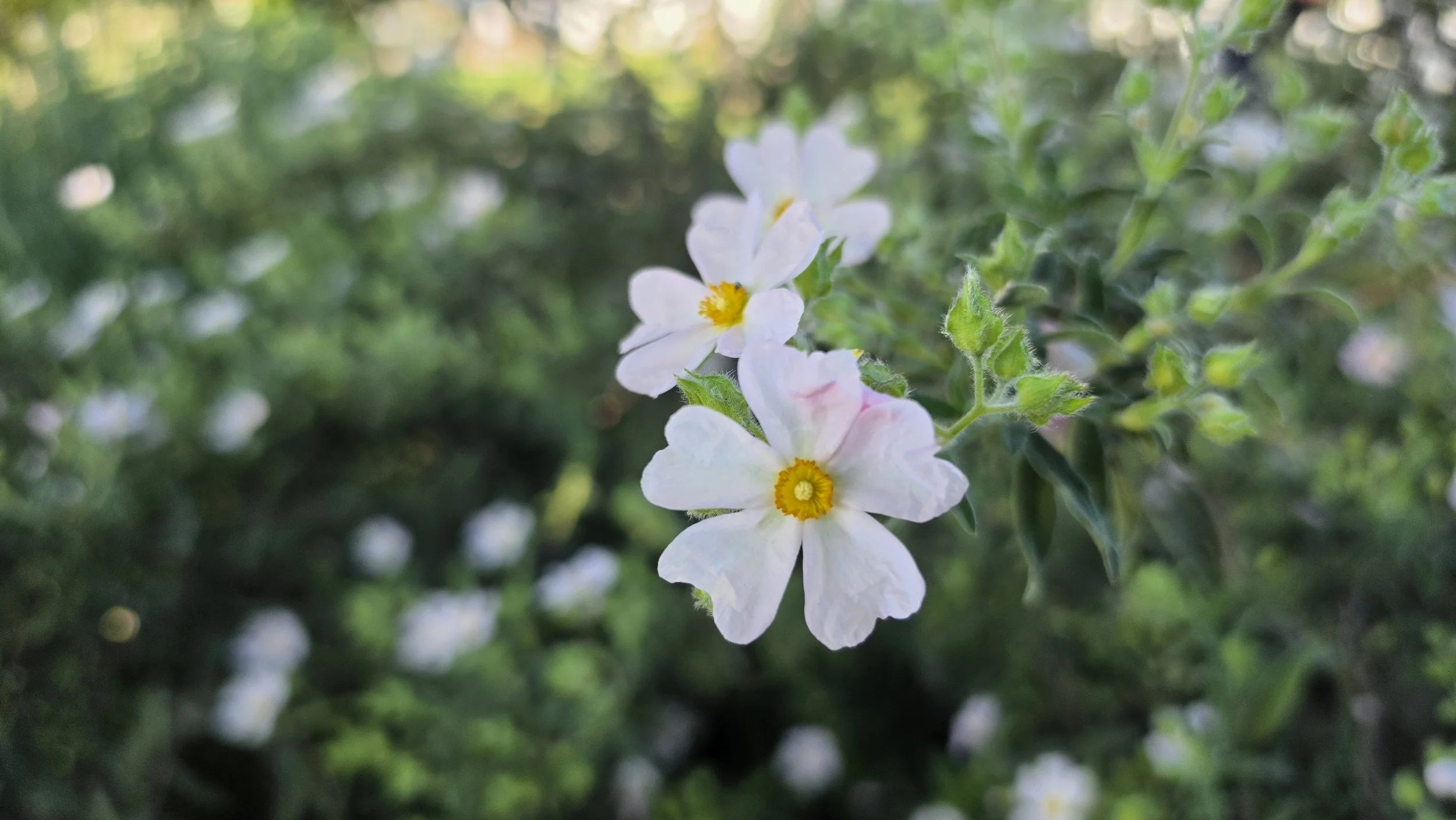
And nature noticed. In the CCC garden, I watched something I've never seen before. A pink rock rose — a plant that reliably produces vibrant pink flowers — bloomed entirely white. The extreme heat had cooked the pigment right out of the petals. I've been gardening in Southern California for a long time, and this stopped me in my tracks. It was a small thing, one plant in one garden, but it was a message — the kind of message nature sends when something is deeply out of balance.
In my Master's thesis at the Lyle Center, I explored the concept of "alternative ways of knowing" — the idea, rooted in the work of Gregory Bateson and the EcoJustice framework, that intelligence and communication aren't exclusive to humans. The wind turning leaves to show their silver undersides before a storm. A garden that thrives when you work with its rhythms and struggles when you fight them. One of the teachers I worked with described how young children have an innate sense of their relationship to the world around them — a feeling they can't always articulate, but that they carry in their bodies. He worried that as we grow older, we "box ourselves in" and lose that connection. I think about that often, especially on weeks like this one.
What happened this week is a reminder that the natural systems we depend on — the systems that grow our food, clean our air, regulate our climate, and support the creatures we share this planet with — are not separate from us. As I wrote in the conclusion of my thesis, we who have the capacity to damage the Earth also have the potential to help it heal — not through any particular gift of our own, but by making the conscious decision to slow down and allow the Earth's natural processes to continue unburdened. The EcoJustice framework asks us to challenge the deeply rooted cultural assumptions that separate humans from nature — the idea that we stand above it, outside of it, or in control of it.
We are not in control of it. This week made that abundantly clear.
I don't say any of this to frighten anyone or to start an argument. I say it because I believe what Aldo Leopold believed when he wrote that when we see the land as a community to which we belong, rather than a commodity we own, we begin to treat it with love and respect. And I say it because a rock rose in a garden told me something this week, and I think we should listen.
Thank you for reading this week's issue of Growing with Professor Brown. If you'd like to support my work, please join me during the live stream! See you Monday at 5:30 PM.
