The Time Is Now
Welcome to the Weekly Edition
Late April is one of those moments in the garden that doesn't wait for you. The warm season is here, and if you've been putting off planting your tomatoes, beans, or squash, this is your sign to stop waiting and just do it — even if the timing isn't perfect, even if the setup isn't ideal, even if you're not quite sure what you're doing. The garden will meet you where you are.
This week's newsletter is all about vining plants — I'm sharing updates on four new additions to my parents' backyard, including a passion fruit that's fighting to survive and two chocolate vines that are already taking off. We'll also do a quick last-call roundup of warm-season crops that need to go in the ground as soon as possible, and I'll share some thoughts on why doing something imperfectly is always better than doing nothing at all.
The Monday Garden Office Hour livestream this week is focused on planting chayote and garden troubleshooting — tune in live or catch the replay. Join us here: Garden Office Hour: Planting Chayote & Garden Troubleshooting
Let's get into it.
For Students
Regenerative Gardening — Week 10: Use Appropriate Technology
This week in Regenerative Gardening we are covering Principle Five: Use Appropriate Technology. This is one of my favorite classes of the semester, and I really hope you'll make it out — last time we ran this class, attendance was lower than usual, and those who missed it really missed out.
Here's why: we're doing a garden tool relay. I'll be setting up stations around the room, each with questions or discussion prompts focused on tools, technique, and the principle of using what actually fits the job. You'll rotate through in small groups, discuss, and answer — and I'll be circulating to check in with everyone. It's hands-on, it's interactive, and it's a lot of fun.
We'll also be doing a tool show-and-tell — I'm asking everyone to bring in their favorite garden tool and be ready to share what it is and why you love it. This ties directly into our group discussion: What is your favorite tool, and why? It can be anything — a hori-hori, a broadfork, a good pair of pruners, even a humble hand trowel. If you've got something you love using in the garden, bring it in.
If you're on the fence about coming — come. This one is worth it.
Fundamentals of Sustainability — Week 10: Climate Change and Atmospheric Carbon
This week in Fundamentals of Sustainability we're tackling one of the most important topics of the semester: climate change and atmospheric carbon. The syllabus calls for us to examine the science behind climate change and its impacts, while exploring practical strategies for adaptation and mitigation — and that's exactly what we'll do.
We'll start from the ground up, working through what carbon actually is, how it moves through our atmosphere, and how that connects to the changes we're already seeing in our climate. From there, we'll move into real, practical solutions — the kind that communities, businesses, and individuals can actually act on. There's a lot of noise out there on this topic, and a lot of proposed "solutions" that deserve a closer look. My goal, as always, is to make sure you leave class with the tools to think critically and do your own research.
A Note on the California Conservation Corps
Last Friday, April 18th, marked the final class of the semester for our Friday morning 8:00 AM California Conservation Corps cohort. It has been a genuine privilege to spend Friday mornings with that group, and I'm going to miss it more than I expected.
That said, this isn't quite goodbye — I'll be stopping by the CCC site on some Thursday afternoons around 3:00 PM over the next few weeks. I have a few things to drop off, and I want to check in on the garden.
To my CCC students: please keep an eye on the plants. Make sure everything is getting watered, and keep an eye on those tomatoes — several are close to ripe, and I don't want them to go to waste. Also, as the tomato plants grow and start pushing up against the edges of the chicken wire protection, please expand and adjust the wire so the plants don't get caught up in it. The plants are doing well — let's keep them that way.
Videos from This Week's Classes
Here are the videos we watched in class this week. If you missed class, these are worth your time — and if you were there, they're great to revisit.
Regenerative Gardening — Fundamentals of Regenerative Gardening, Week 9: Container Gardening
How to make a wicking pot so your plants self-water | DIY Garden Projects | Gardening Australia
Self-watering Planter Basics: How to Design DIY Gardening, Sub-irrigated, Wicking Beds (Albopepper)
Fundamentals of Sustainability, Week 9: Water, Fuel, and Waste
In the Garden
Last Call: Get Your Warm-Season Crops in the Ground
If you haven't planted your warm-season vegetables yet, now is the time — and I mean right now. As temperatures rise through May and into June, the window for young plants to establish their root systems before the heat sets in gets shorter fast. Plants that go in the ground stressed, shallow-rooted, or late will struggle through summer rather than thrive.
Here's a quick list of warm-season crops to prioritize getting in the ground as soon as possible:
Tomatoes — the classic California summer crop; get transplants in now so they can root deeply before the heat arrives
Beans — direct sow bush or pole varieties; they germinate quickly and love warm soil
Summer squash and zucchini — fast-growing and rewarding; direct sow or transplant now
Cucumbers — warm soil is essential; they'll sulk in cool ground but take off quickly once conditions are right
Melons — need the longest warm season of any of these; if you haven't started, do it this weekend
Corn — direct sow in blocks for good pollination; needs warmth and space
Peppers and eggplant — slower to establish than tomatoes but love the heat; transplants only at this stage
The goal isn't perfection. It's getting roots in the ground while there's still time for the plant to do something with them. A tomato planted today in imperfect conditions will almost always outperform a tomato planted in perfect conditions three weeks from now.
Vining Plants: Growing Up and Out
One of the most space-efficient strategies in any garden is to grow vertically — and vining plants are some of the most rewarding things you can grow once you give them something to climb. This week I want to share four vining plants that are currently growing at my parents' backyard: a passion fruit, two chocolate vines, a goji berry, and a newly planted lollipop grape. I'll also be talking about chayote, which I'm planning to start soon.
One important note before we dive in: not all vining plants are self-fertile. Some, like passion fruit, will produce fruit on their own. Others — like kiwi, and as I recently discovered, the Akebia chocolate vine — need more than one plant, and sometimes specifically a male and a female. Before you purchase a fruiting vine, do a little research to find out what you actually need to get fruit. It can save you a lot of waiting and wondering.
Passion Fruit
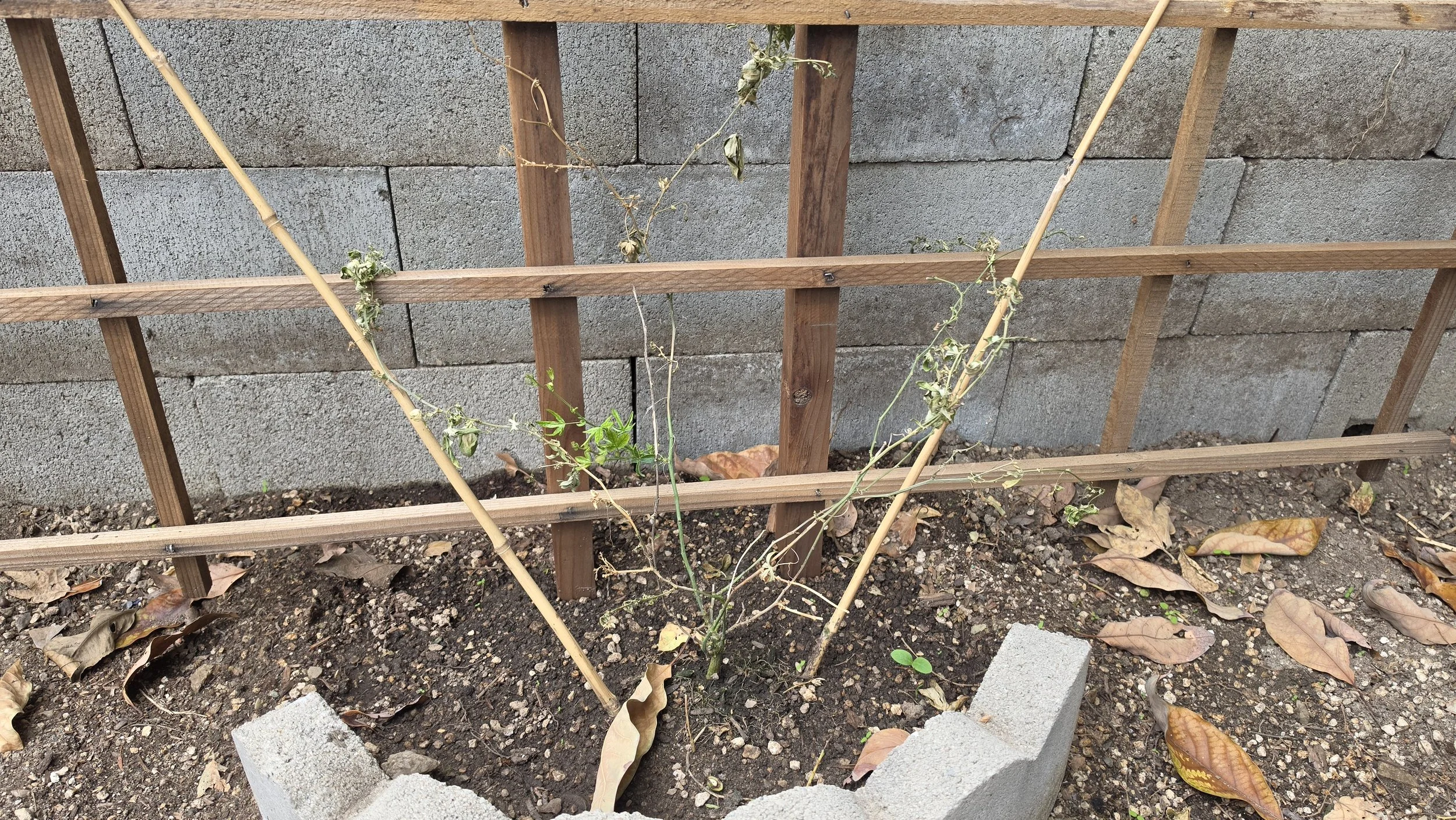
This one has a story.
When I picked up this passion fruit from Armstrong's, it already looked rough — the staff even apologized for its condition when I brought it to the register. After I got it in the ground, nearly everything on it died back. I was genuinely worried I'd lost it. But if you look closely at the center of the photo, you can see something: a small cluster of new leaves and a single live stem pushing back out from the base.
I'm holding onto it. Armstrong's guarantees their plants and I could return it, but I want to give this one a chance to come back on its own. If it completely fails, I'll take them up on that offer. For now, I'm watching, watering carefully, and waiting.
The passion fruit is currently growing against a wooden trellis, with a chain-link fence off camera to the right. The trellis alone won't be large enough for a mature passion fruit — these plants can get very large — so as it grows out, I'll start training it over onto the chain link. Passion fruit is one of the easier vines to manage in that way; it grabs on readily and doesn't need much coaxing.
One more thing worth mentioning: passion fruit is self-fertile, meaning you only need one plant to get fruit. That's not true of all vines, so it's always worth looking this up before you buy.
Chocolate Vine (Akebia quinata and Akebia × quinata 'Shirobana')
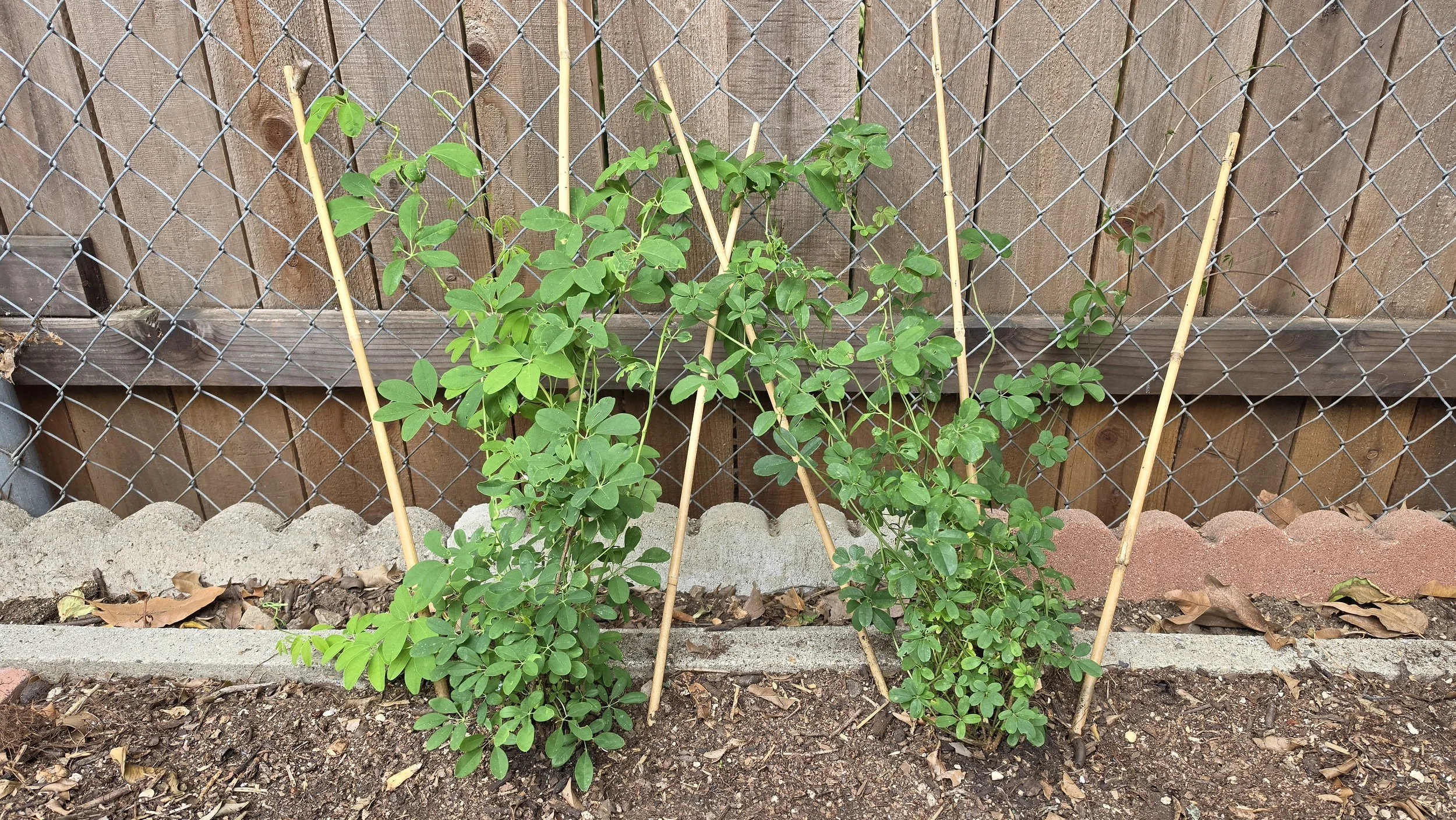
What a difference a week makes.
These two chocolate vines — one standard Akebia with deep purple flowers, and one Shirobana variety with white flowers — went in the ground about a week ago, and they are already putting on impressive growth. Both plants look lush and healthy, and I'd estimate each has grown several inches since planting. I've only watered them twice since they went in, letting the top couple of inches of soil dry out before watering again. So far, they seem to be settling in beautifully.
Here's something I didn't know when I bought them: Akebia needs two plants to produce fruit. I originally purchased both because I liked the idea of having two different flower colors intermingling on the fence. It was only after I got them home and did a bit more research that I found out two plants are actually required for pollination. Happy accident — and a good reminder to always look into a plant's fruiting requirements before you buy.
A couple of things to know if you're thinking about growing Akebia: these are vigorous vines that can reach 20 to 25 feet wide at maturity, so give them room. The flowers are said to smell like chocolate — I haven't experienced this yet, and I can't wait. The fruit is described as a blend of lychee, melon, and coconut, which sounds extraordinary. I'll report back when we get there.
One thing I'm watching carefully: Akebia is reportedly prone to powdery mildew. I haven't seen any yet, but I've also noticed that something has already started nibbling on a few leaves. I'll be keeping a close eye on both issues as the season progresses.
Goji Berry
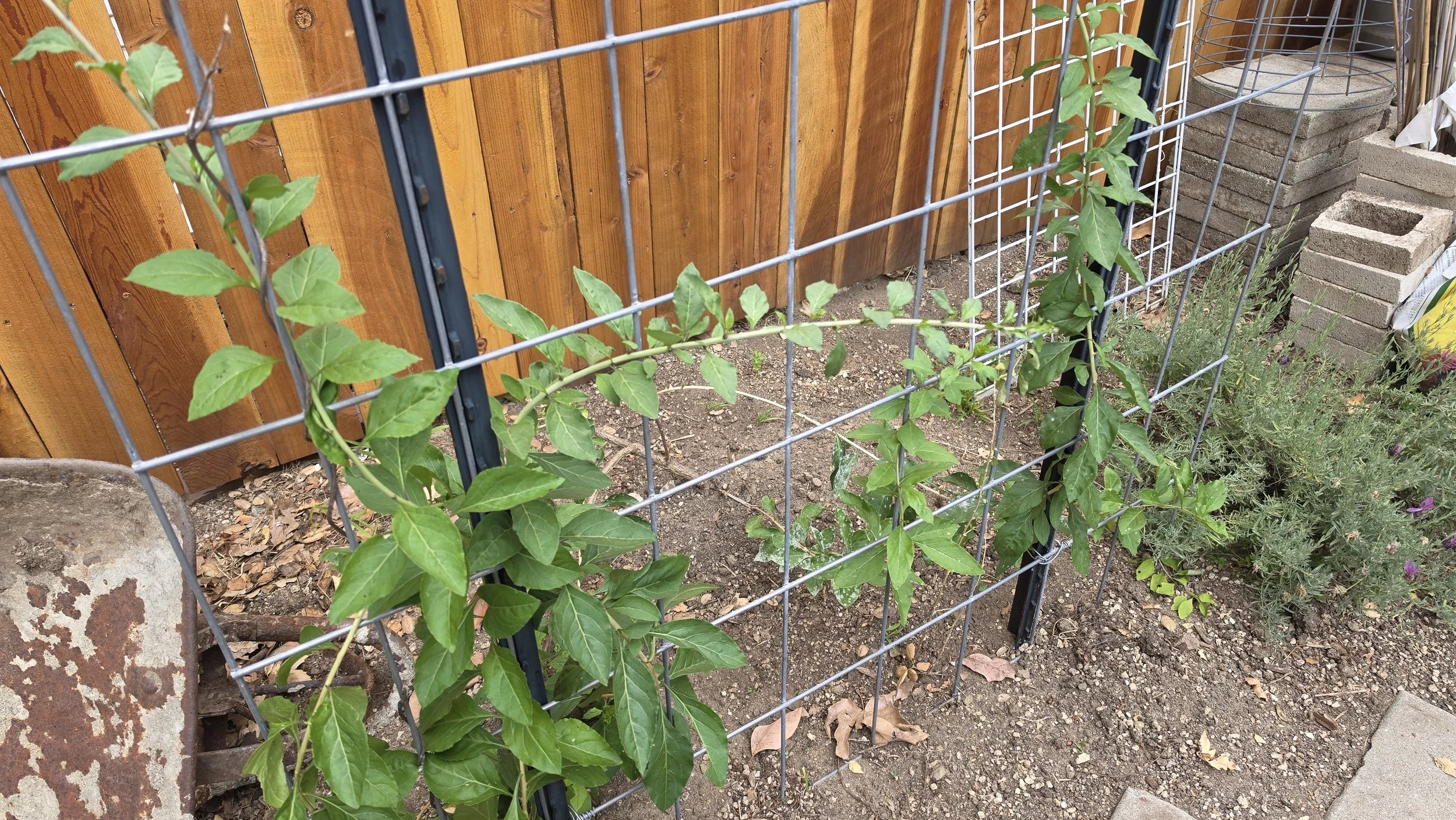
The goji berry has been growing in my parents' garden for several years now — my father's plant, really — and last year was the first time it produced a meaningful harvest. The only problem was that we were so used to it not fruiting that we almost missed it entirely. By the time we noticed the berries, the season was nearly done. This year, we're paying much closer attention.
If you look at the center of the photo, you can spot some powdery mildew on the lower leaves — that's actually why we just cut the plant back significantly and started retraining it on this trellis. I'll be stripping off the most heavily affected leaves and treating with Revitalize, a biofungicide that uses beneficial bacteria to help trigger a kind of immune response in the plant. I've used it before with good results, though it's not a miracle worker — it won't clear up a severe infestation on its own, which is why removing the affected material first is so important.
Goji berry is a well-known superfood, high in antioxidants, and it does grow well in Southern California — but if you're in a spot with poor airflow, powdery mildew can be a recurring challenge. Plant it somewhere with good air circulation if you can. It also tends to die back every year and re-emerge from the roots, so don't panic if it looks rough in winter.
Lollipop Grape
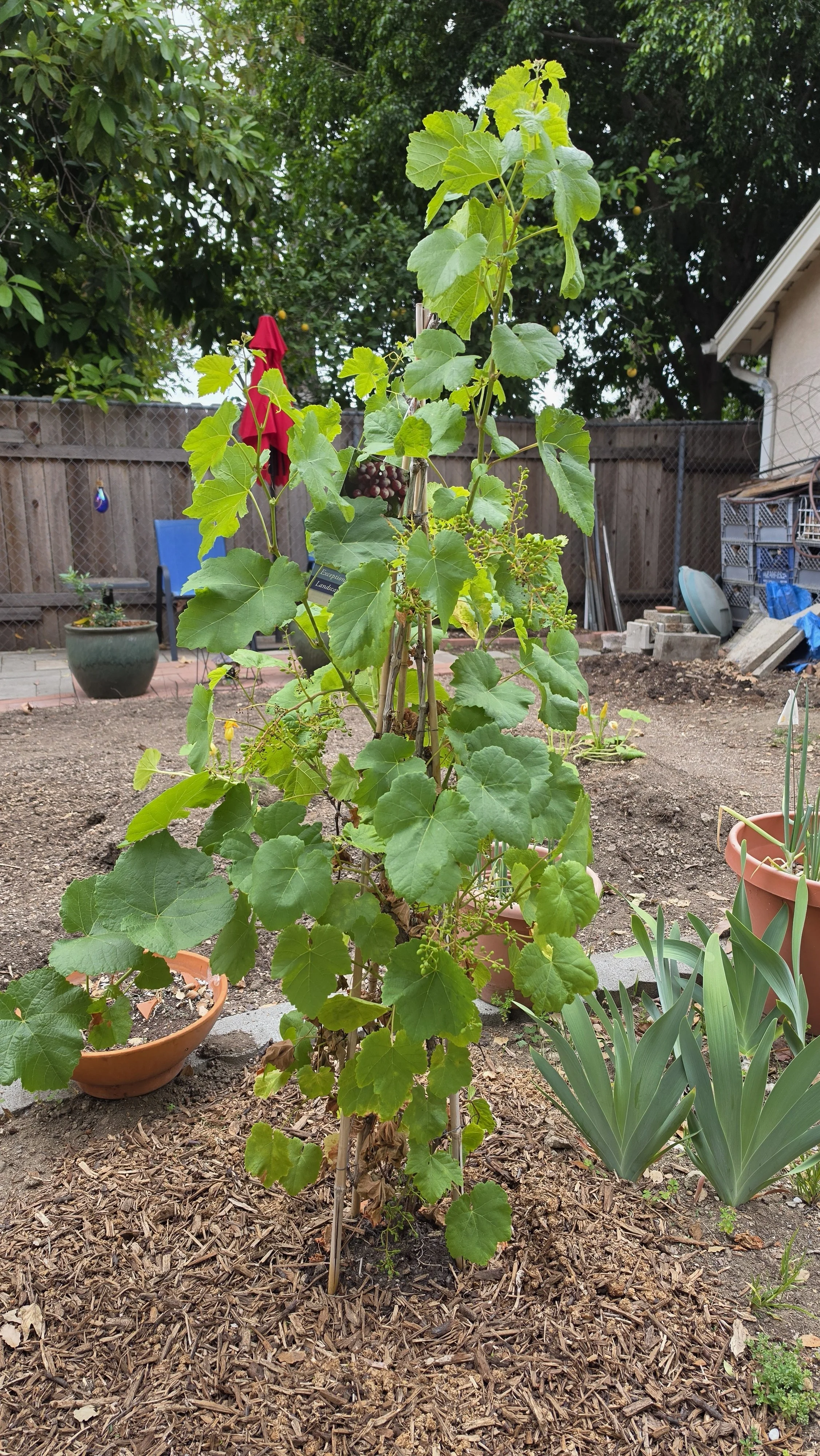
Those who have been watching the livestreams will recognize this one — I started planting it on air and finished after the stream ended. It's a Lollipop grape, a purple variety I've never tasted before but am very much looking forward to. It's said to be quite sweet.
You'll notice in the photo that it's already forming small grape clusters. The technically correct thing to do at this stage would be to remove them so the plant can direct its energy toward establishing roots rather than producing fruit. I am not doing that. My dad wants to taste them, so we're leaving them on.
The plant still needs an arbor — we have fence posts on either side and a plan to run wire between them to create a simple training structure. That's coming soon; I just haven't gotten to it yet.
One thing I love about grapes that not enough people talk about: the leaves are edible. Grape leaves have been used in Middle Eastern cooking for generations — most famously in dolmas, stuffed grape leaves, which I grew up eating and have always loved. Once this plant is established and putting on strong new growth, I'm planning to harvest some leaves and try making my own. It's a good reminder that doing a little research on a plant often reveals that far more of it is usable than you might expect. Just make sure you understand how to prepare what you're harvesting — grape leaves, like many edible plant parts, need proper preparation before eating and shouldn't be consumed raw.
Chayote — Coming Soon
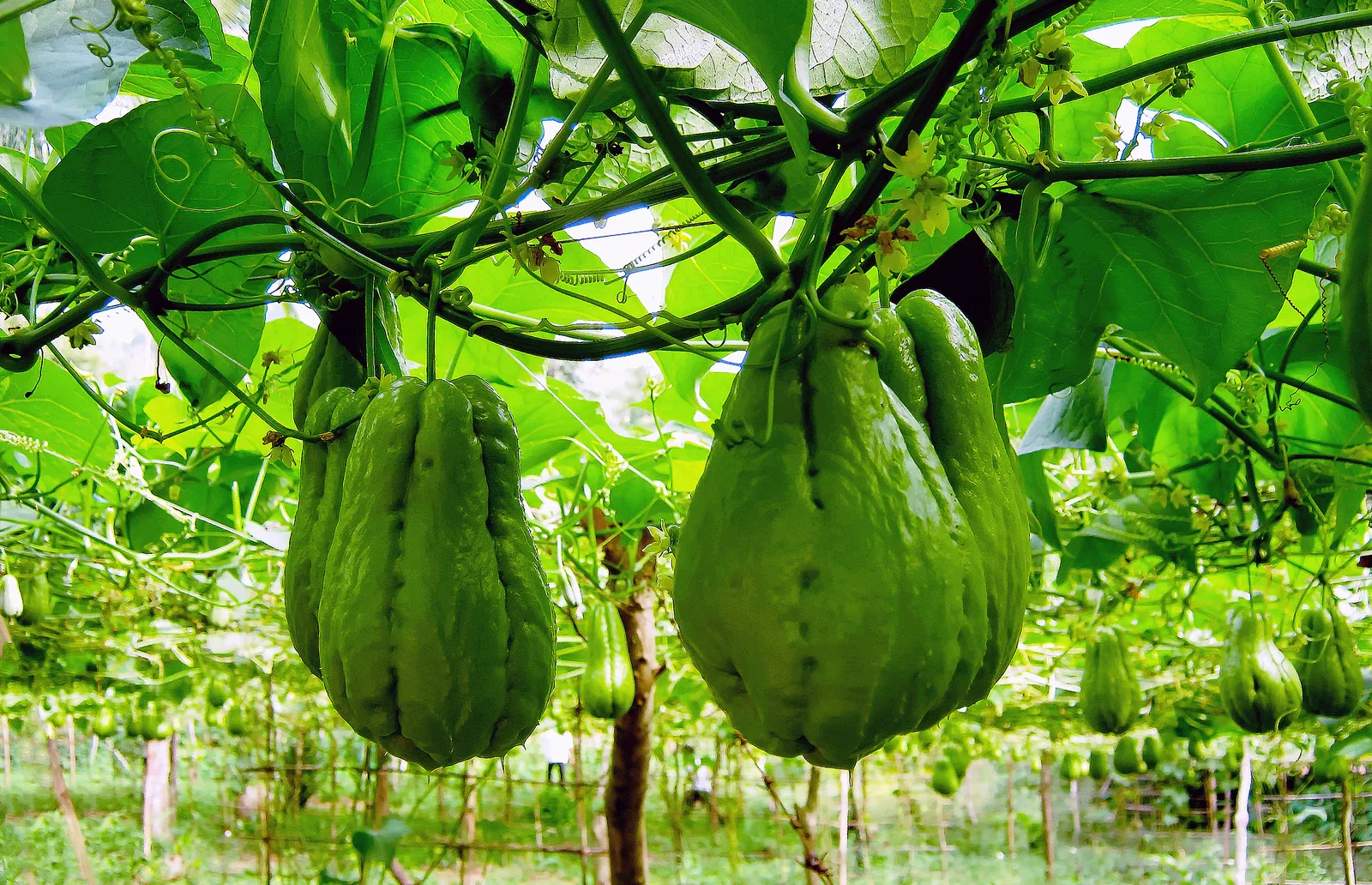
[Photo: Stock image of chayote vine with fruit — personal photo coming once plant is established]
I'll be honest: I'm planting chayote a little later than ideal. But I'm doing it anyway.
Chayote (Sechium edule) is a vigorous vining plant native to Mesoamerica that produces a mild, versatile squash-like fruit. It's enormously productive once established — a single plant can produce dozens of fruits in a season — and it's well-suited to Southern California's climate. The fruit, the shoots, and even the roots are all edible, making it one of the more utilitarian vines you can grow.
The standard advice is to get chayote started earlier in spring, giving it maximum time to establish before the end of the warm season. I'm getting mine in a little late, but I still think it's worth doing. The plant grows quickly, and even a shortened first season can be productive. I'll share photos and an update as soon as I get it in the ground.
Thought of the Week
At the San Dimas Arbor Day event yesterday, I got into a conversation with someone who told me they really wanted to start a garden — but that they were afraid to. Afraid of doing it wrong. Afraid of killing plants. Afraid, I think, of beginning something and not knowing how it would turn out.
I've heard some version of this more times than I can count. And I always say the same thing: just do it. Do it wrong if you have to. Do it with every intention of failing, if that's what it takes to actually start.
There is nothing wrong with failing in the garden. The worst thing that can happen — the only outcome I'd actually call a loss — is that you never start at all. A dead plant is experience gained. A season that didn't go the way will help you prepare for the next one. But a garden you never plant? That's just a garden that never existed.
Years ago, when I was a student at Mt. SAC, Tom Spellman came in as a guest instructor to teach us about pruning fruit trees. And I remember him saying something that has stuck with me ever since: the hardest part of pruning is just getting started. He told us that if we made a bad cut, we would learn from it — and the tree would keep growing, and we'd have another chance to do better. The tree doesn't hold a grudge. The garden doesn't either.
Look at the passion fruit in this week's newsletter. I bought a plant that was already struggling, planted it anyway, and watched almost everything on it die. But there's a new stem coming up from the base. I'm leaving the grapes on my newly planted lollipop grape even though I shouldn't, because my dad wants to taste them. I'm getting chayote in the ground later than I'd like, because later is still better than not at all.
Plants don't wait for perfect conditions. They grow toward whatever light they can find, put roots into whatever soil they're given, and keep trying until they can't. We would do well to garden the same way.
So if you've been waiting — for the right time, the right setup, the right amount of knowledge — stop waiting. The season is here. Make the cut. Plant the seed. You can figure out the rest as you go.
And honestly? This isn't just a gardening lesson. It applies to everything. We can't always hold out for the perfect moment to take action — in the garden, in our work, in our lives. Do what you want to do while you are able to do it, before the window closes. If you have something on your bucket list, or just something sitting on your mind, and you're asking yourself when the right time is — here is your sign. The time is now.
