Everything Comes Back Around
Welcome to Issue 18,
This week brought a small piece of magic I didn't see coming — a sugarcane tasting, a garden tour, and a connection that's been quietly waiting in the wings for years. I'll get into it below. There's also a meaty section on irrigation math (a student asked, and I think a lot of you have been wondering the same thing), a heads-up on spider mites, and a Thought of the Week that wandered into territory I didn't expect when I started writing it.
Join me Monday for Garden Office Hours at 5:30pm: Monday Garden Office Hour Livestream. I'll be doing a yard update, showing how I pruned the tomatoes, checking on the chayote, and planting up a few areas while we talk about your gardens too.
Let's dig in.
For Students
Registration Week — Please Read
This is registration week for summer and fall classes. Here's how it works depending on which class you're in:
In-person students: I'll have registration cards in class and will give you time to fill them out. Easy.
Online students: You'll need to register through the online form. I can no longer help with this directly — the office handles it all now. Here's the process:
Step 1: Apply at mtsac.edu/noncreditapp. If you need help, tech support info and a live support Zoom link are available here.
Step 2: After the application, you can call or email the office to register if you have any trouble with the website: 909-274-4192 or vre@mtsac.edu.
If you have questions, please reach out — and if any of your friends or family have been thinking about taking one of my classes, this is the week to get them signed up.
Regenerative Gardening — Week 11
We're heading into Week 11, and we've got a lot to cover.
We'll start with Your Garden in May — our usual monthly group discussion where I want to hear what you're planning for your gardens this month, and I'll walk through what to expect over the course of May with monthly reminders for things to keep on top of.
After that, we have a lecture on indoor gardening — an introduction to growing plants indoors and keeping them healthy. We'll also cover an introduction to plant nutrients, including NPK and how to remember what each one does (this is one of those things that sticks better with a memory trick, so I'll share mine). If we have time, we'll wrap up with a look at an invasive pest — I haven't picked which one yet, but we'll dig into something practical.
Fundamentals of Sustainability — Week 11
This week we're tackling life cycle analysis and carbon footprints. Life cycle analysis is the framework we use to understand the environmental impact of a product from production all the way through to its end of life — and it's one of the most important tools we have for thinking clearly about sustainability.
We'll talk about carbon footprints and why they matter, but I also want to push us to look at the complete picture. Carbon is one byproduct of our society that can cause harm to future generations — but it's not the only one. Pollution, environmental destruction, water use, waste — all of these matter too. The goal is to balance the full set of impacts, not just optimize for one number.
A Note for My Online Students
I want to remind everyone in the online classes that I've been posting weekly class reviews on the discussion board. I take the transcripts from our class meetings and run them through an AI tool to create a summary of what we covered, including the discussions we had together. It's a really good way to revisit material from earlier in the semester.
This week I want to encourage all of you to head over to the discussion board, pick one week that interested you, read through the review (you don't have to read the whole thing — just skim what catches your eye), and then post a reply with your thoughts. What stuck with you? What was most valuable? Was there anything you wish we'd gone deeper on?
You don't need to do this every week. But especially when there's a topic you really care about, going back through it and writing up a response is one of the best ways I know to make information stick. And when you reply in the group discussion, your thoughts can help other students who are reviewing the same material. Since this is a free class with no formal homework, this is an optional way to deepen your learning if you have the time and interest.
A Quick Apology About Last Week's Livestream
I owe everyone an apology for the trouble we had starting last Monday's livestream. I figured out what happened, and it was 100% my fault. When I set up the stream, I told the system I'd be streaming from a webcam instead of a mobile device — and that's why my phone wouldn't let me start the stream. I'm sorry for the wasted time at the beginning. Won't happen again. I'll see you all at 5:30pm Monday at the livestream link.
Videos from This Week's Classes
Regenerative Gardening
Fundamentals of Sustainability
A Beautiful Afternoon at The Great Sugarcane Squeeze
This past weekend, my dad and I had the chance to attend an event called The Great Sugarcane Squeeze, hosted by zerowastefarmer here in our area. I almost missed it — I only heard about it through one of my students who lives nearby and mentioned it during class this week. At first I didn't think I could make it, but I shifted my schedule around so we could catch the last offering together. My father is healing right now, and it was a good chance for the two of us to get out and spend some time in a beautiful place. We both enjoyed it very much.
I want to share something about this event because there's a connection here that I find a little remarkable.
The host of the event, Manju Kumar, is the mother of Farmer Rishi — a well-known regenerative gardening advocate in our area. Farmer Rishi started the school garden at Diamond Point Elementary, where I worked for several years as the school garden coordinator. After the district eliminated that position, I continued to volunteer there until the school shut down a few years back. In all those years, I never actually met Farmer Rishi himself — and now I've met his mother, but still not him. There's something funny and lovely about that to me.
The event itself was wonderful. We got to try three different sugarcane juice combinations — one with mint, one with blackberries and hibiscus, and one with toasted cumin seeds, black salt, and tamarind. All three were incredible. They poured generous eight-ounce servings, but we’re watching our sugar, so we just had a taste of each. Even a small amount was a treat.
After the tasting, Manju led us on an educational tour of her garden — and friends, this is one of the most impressive regenerative spaces I have ever seen in our region. Her front, side, and back yards have all been transformed into a thriving food forest. She talked about the importance of soil and her focus on mulch as a foundational practice. But the part that really stuck with me was when she mentioned comparing her water bill to her neighbors'. Despite having dramatically more plants, more food production, more life in her yard than anyone else on her block — she uses about the same amount of water. That's what healthy soil and a well-designed polyculture will do. The system itself becomes more efficient.
This is exactly what I'm always trying to teach you in class. Polycultures, food forests, healthy soil, and regenerative practices create healthier, happier, more productive systems — and Manju's yard is a living example of it.
I want to encourage every one of you to follow zerowastefarmer on Instagram and, if you ever get the chance, attend one of her events or visit her garden. As much work as I'm doing on my parents' yard, there's only so much I can do given what they want for their space. If I had my own home, Manju's yard is exactly how I'd design my landscape. That's the system I want to build someday. I think that's about the best thing I can say about it.
Going forward, when I hear about events like this earlier, I'll share them with you in the newsletter so you have the chance to attend too.
In the Garden
Irrigation, Mulch, and Staying Ahead of the Heat
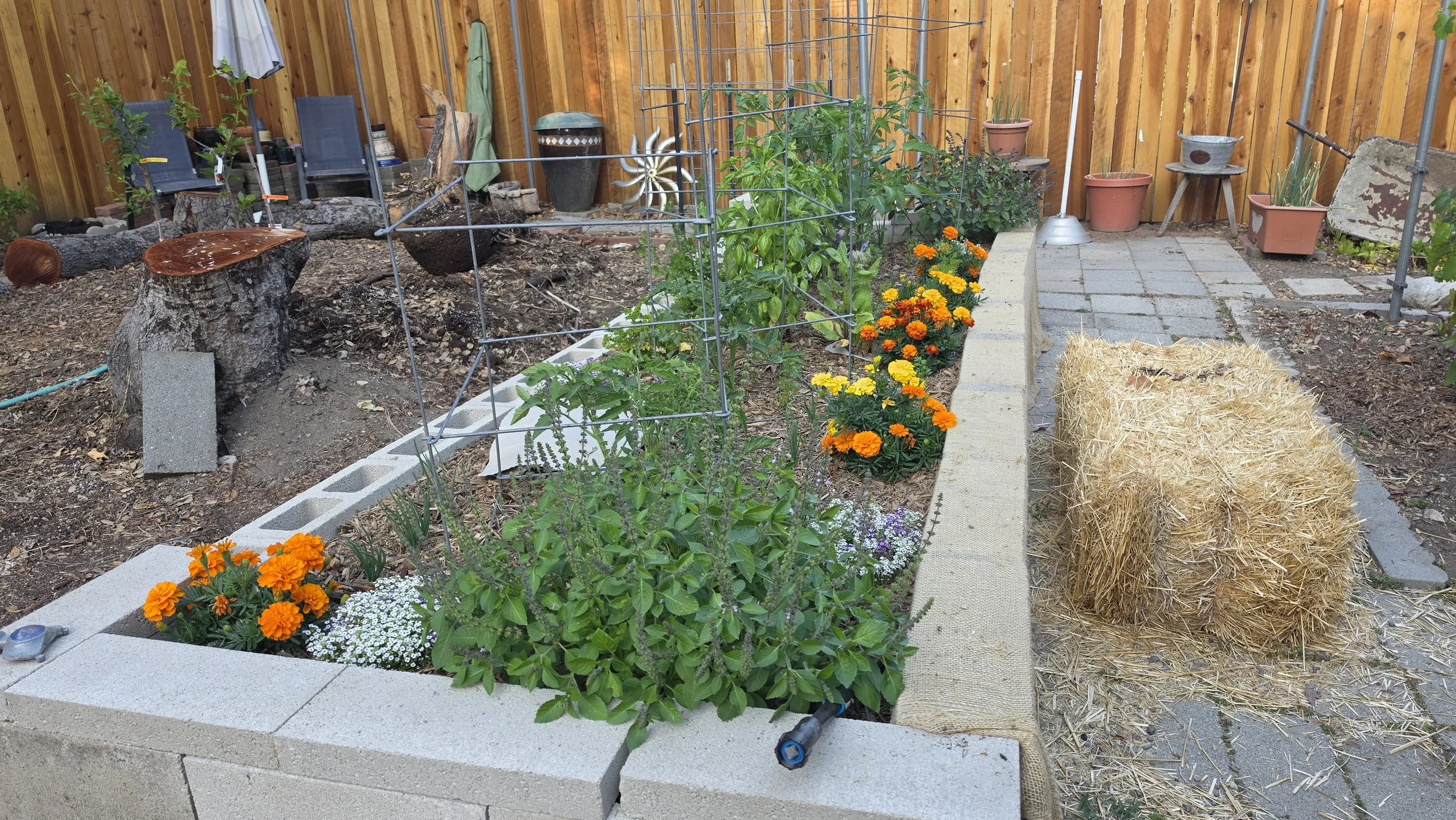
This is the most recent photo of my hugelkultur raised bed at my parents' place, taken just yesterday evening. Before I dig into the irrigation math, I want to point out something exciting — the two stunted tomatoes on the west end of the bed finally took off. If you've been reading the newsletter for a few weeks, you may remember I was watching them carefully and considering whether I'd need to replace them. I just kept watering them the same as the others, gave them a little patience, and over the last week or so they've put on tremendous growth. They're still smaller than the two on the east end, but they made it. Sometimes a plant just needs a little time and a little love.
I also pruned the tomatoes this week — lifted the lower branches up off the soil to improve airflow underneath them, which helps prevent disease and pest pressure. I'll show you exactly how high I pruned during Monday's livestream, so tune in if you want a closer look.
How I Calculate My Drip Irrigation Run Time
A student asked me this week how I figure out how long to run my drip irrigation. I want to walk through the actual math using this bed as the example, because the same approach works for any drip system once you know your numbers.
Here are the bed specs:
Dimensions: 151 inches long × 41.5 inches wide
Total surface area: about 43.5 square feet
Depth: somewhere between 18 and 24 inches (I built it as a hugelkultur, so the bottom is stacked with logs and branches from the avocado tree we removed, plus shredded organic material, a bag and a half of worm castings, and a generous layer of coffee grounds — all topped with about 7 to 8 inches of raised bed mix inoculated with starter fertilizer)
A quick note on the fertilizer — I used more than I normally would, both in the bed mix itself and in each individual planting hole. As those logs at the bottom break down, they actually pull nutrients away from plants in the short term. So I front-loaded fertility to make sure the plants weren't getting starved while the wood does its slow work.
Here's the drip system:
Half-inch mainline running along the outside edge
Quarter-inch lines delivering the water — four parallel runs spaced roughly 9 inches apart (they wobble a bit because I had to route around worm bins and other obstacles)
Emitter spacing: every 12 inches
Approximately 50–52 emitters total (full disclosure — I didn't actually count them when I cut the line, and I should have)
Flow rate: 1 gallon per hour per emitter
So my total system output is about 52 gallons per hour.
Now here's the math for figuring out how long to run it.
A good baseline target is roughly 1 inch of water per week for most vegetable beds. One inch of water over one square foot equals about 0.623 gallons. So:
43.5 sq ft × 0.623 gal = about 27.1 gallons per week
I round up and aim for 30 gallons per week to give myself a little cushion. To deliver 30 gallons at a flow rate of 52 gallons per hour:
30 ÷ 52 = about 35 minutes per week
That's the baseline. But honestly, I've been running it 40 minutes a week — split into two 20-minute runs — for two reasons. First, splitting waterings helps the moisture distribute more evenly. Second, because of those logs at the bottom of the bed, I want the water to soak deep. As the wood breaks down and becomes spongy, it'll act like a built-in reservoir, holding moisture deep in the bed. Encouraging fungal life and soaking those logs now sets up the long-term health of the whole system.
One more thing: always watch your plants. The math gets you in the right ballpark, but the plants are the final word. If they start looking a little sad between waterings — leaves drooping in the evening, slowed growth, dull color — that's your signal to bump up the run time or add a watering. If they're thriving, you're doing it right.
One Last Note on Mulch
If you take one thing from this section, take this: right now is your last good window to get mulch down before summer heat sets in. Early May. Don't wait.
Mulch conserves soil moisture, regulates soil temperature, suppresses weeds, feeds soil life as it breaks down, and dramatically reduces how much you need to water. A 3-to-4-inch layer of wood chips, straw, or shredded leaves can cut your water needs significantly through the hot months. This is one of the highest-leverage things you can do for your garden right now.
I'm practicing what I'm preaching — I have several areas of the yard that still need more mulch. I've been waiting on some carrots and shallots to come up before adding the last bit of mulch in the raised bed. They're at a good size now, so I'll be finishing that work tomorrow. I'll likely have to go pick up another load too, because I don't have nearly enough on hand to cover everywhere that needs it. So if you see me telling you to mulch — know that I'm out there doing the same thing.
Pest Watch: Spider Mites and the Beneficial Insects I Use
Late May to June is when spider mite pressure starts building, especially on tomatoes. If your tomato plants are reaching a mature size, now is the time to start inspecting them carefully. Look at the undersides of the leaves for fine webbing, and watch for stippled or dull-looking foliage — those are the early warning signs. Spider mites are tiny and easy to miss until the population explodes, so catching them early matters.
The biological control I use and recommend is green lacewing larvae. Lacewing larvae are voracious predators that go after spider mites, aphids, thrips, whiteflies, and other soft-bodied pests. The trick is to release them when your tomatoes are reaching mature size but before you really start noticing spider mites taking over — get the predators in place before the pests get ahead of you. I'll be releasing some myself very soon.
I order mine from Nature's Good Guys through Amazon. Two options:
1,000 lacewing eggs — about $10
5,000 lacewing eggs — about $16 - usually the best value per egg without going too overboard
A heads-up worth knowing: shipping is around $15 regardless of which size you buy. That makes the 1,000-egg pack effectively $25, while the 5,000-egg pack is a much better deal per egg. That said, 5,000 eggs is more than most home gardeners actually need — a thousand will go a long way for a typical backyard tomato patch.
A Note on Affiliate Links and Recommendations
The links above are Amazon Associates affiliate links, which means I may earn a small commission if you purchase through them — at no additional cost to you. I want to be fully transparent about this. I'll be launching a Recommendations page on my website soon featuring the products I personally use and trust, and I want to be clear with all of you about how that works.
I will never recommend a product just to earn a commission. Everything I link to is something I actually use, have tested, and would recommend to a student or a friend. The affiliate program is just a way to earn a little on the side from things I'm already telling you about.
Whenever possible, please support your local nurseries, feed stores, and small businesses before going to Amazon. We're all navigating a tough economy, and small local shops need our support more than ever. Amazon has its place for some items, and may be the option for some folks to order specific items — but whenever possible, support independent businesses first. They need our support.
Thought of the Week — Everything Comes Back Around
When I interviewed for my teaching job here at Mt. SAC, I spent part of the conversation talking about my work as a school garden coordinator at Diamond Point Elementary. I was deep into telling some story about the garden — I don't even remember which one anymore — when the interviewer cut me off mid-sentence to tell me I had the job.
At least, that's how I remember it. That's the version I tell my students, anyway.
I've thought about that moment a lot over the years, because so much of what I'm doing today traces back to that school garden. The garden I worked in at Diamond Point was actually started by Farmer Rishi — the same regenerative gardening advocate whose mother I just met this past weekend. I never met him directly. But the garden he planted led to the job I took, which led to the people I met at the Lyle Center at Cal Poly Pomona, which led to my master's, which led — eventually — to me standing in front of a classroom telling students about regenerative gardening. I've been walking in his footsteps for years without even knowing I was doing it.
And then a student of mine — someone who happened to live near Manju — mentioned an event during class. And my schedule somehow opened up. And there I was Saturday afternoon, drinking sugarcane juice with my dad in the garden of the woman who raised the man whose work helped shape my path.
You can't plan for things like that. You can only notice them when they happen.
A Story I Wrote Years Ago
Years ago, in my first English class here at Mt. SAC, I wrote an essay about serendipity. The personal experience I wrote about in that essay has stayed with me my whole adult life.
I have a sort of personal rule: if someone asks me for food, I give it to them. I've bought meals for strangers many times over the years. The first time I ever did it, I was with my dad, and we walked past a man outside a Mexican restaurant who asked us if we had anything to eat. We said sorry and walked inside. After we ordered our food, I turned to my dad and said, "You know — he didn't ask for money. He asked for food, didn't he?"
I went back up to the counter, ordered a big burrito, and walked it outside to him.
What happened next I wasn't expecting. The man got down on his knees in front of me, started to cry, and said he would pray for me.
That moment broke something open in me. It was the first time I'd ever bought food for a stranger, and the depth of his response — the gratitude, the weight of what a single meal meant to him — changed how I moved through the world from that day forward. I made a promise to myself that I would never turn down someone asking for food who genuinely needed it. I've kept that promise for years now.
That moment was serendipity to me. Completely unexpected. Quietly life-changing.
Bringing It Back to the Garden
I've been thinking about how this connects to the garden, and I think it does.
We humans put fences around a piece of land, declare it ours, and then become so upset when another creature comes in and takes some of what we've grown. As if we have the rightful claim to the energy of the sun, the rain, the fruit of the soil, the nurturing of the Earth. As if any of it actually belongs to us.
I'm not saying we should let critters strip our gardens bare. We work hard for what we grow, and there are real reasons to protect a harvest. But I do think we have to ask ourselves, sometimes, when we lose a tomato to a bird or a few greens to a rabbit — did I really need that one? Is there still enough? Can I share? And if there is enough — can we let go of the loss and feel a little camaraderie with the other creatures we share this place with?
Because here's what I keep coming back to: we are all kin. All the other people. All the other animals. The plants, the fungi, the soil itself. We all share life. We all share this Earth. The closer we can get to that truth in how we live, I believe the closer we can get to God — to the Universe — to whatever you want to call the reality that lies beyond the human-centered world so many of us find ourselves living within.
The garden teaches us this if we let it. Everything comes back around. The student who tells me about an event. The school garden that led to a job. The man on his knees outside a restaurant. The fence we put up and what we choose to do when something climbs over it.
Whether it’s a stranger outside a restaurant or a rabbit in the cabbage patch, the gift is the same.
We are all sharing the same life.
