What World Do I Want to Live In?
Welcome to This Week's Edition
Happy Sunday, everyone. We've reached potluck week — which means good food, the plant raffle, and a chance to celebrate how far we've come together this term.
I also want to be upfront about one change. There won't be a Monday Garden Office Hour livestream this week, and there won't be for a little while. I'm heading into the busiest stretch of my year — the High School HSR program kicks off on June 15th — so I'm making the switch now from Monday livestreams to occasional Saturday mornings instead. I'll announce the first Saturday stream right here in the newsletter and in class, but first I want to put the timing to a vote. I'll ask in class this week which Saturday morning works best for you.
More on the busy season below. For now — let's enjoy the potluck.
For Students
Regenerative Gardening
In-person classes: This is it — our potluck! Bring something to share, come hungry, and let's celebrate the season together. Don’t forget to bring reusable plates and utensils - but don’t worry if you forget. I’ll have backups as always. We'll also be holding the plant raffle, so don't miss it.
Online class: We'll keep things a little lighter this week with a short segment rather than a full lecture, followed by a few questions I'd love your honest feedback on. Your input genuinely shapes how I teach this course, so come ready to share.
Fundamentals of Sustainability
This week we're talking upcycling — taking what might otherwise be waste and giving it a second life. Here's a fun challenge: if you get the chance, find a piece of junk around the house and upcycle it into something useful or beautiful. Bring it to show off during our final class — I can't wait to see what you come up with. We'll close with a short feedback review, too.
Teaching Updates
I want to be honest with you about what the next couple of months hold, because you may notice me stretched a little thin. Starting June 15th, I'll be teaching in the High School HSR program for six weeks. That means my college courses in the mornings, HSR from late afternoon into the evening, and a mountain of grading on top of it — it's a short, intensive summer course with around a hundred students I meet with weekly in 1 on 1 meetings. There's also a graduate course at Cal Poly Pomona's Lyle Center that may land on my plate with little notice, depending on how the timing shakes out.
I'll be straight with you: it's a lot. I've done this before, so I know I can carry it — but it's right at the edge of what I can hold. So I'm asking for a little grace and patience over these weeks if I'm slower to respond or lighter on the extras than usual.
And mostly, I want to say how fortunate I feel. Every one of these is work I genuinely care about, with people who've placed real trust in me. That isn't lost on me, even in the thick of it. (More on that in this week's Thought of the Week.)
Videos from This Week's Classes
As always, here are the videos we explored this week — plus a few extras for anyone who wants to go deeper on their own time.
Regenerative Gardening
Reclaiming the Honorable Harvest: Robin Kimmerer at TEDxSitka
ONEIDA AGRICULTURE: An Oneida Elder Speaks About the Three Sisters Garden
The Three Sisters: Corn, Black Beans and Squash | Relish with Yia Vang
Fundamentals of Sustainability
In the Garden
Worm Castings and Worm Tea
I finally got myself a worm tea setup for the garden at my parents' place, and I'll admit I'm a little giddy about it. I've worked with worm tea before, but I've never had a rig of my own to tinker with. Right now I'm still in the setting-up stage — I haven't brewed my first batch yet — but I will be soon, and I'll be sharing the whole experience with you in my next video. Think of this as the "before" picture.
If it's new to you: worm castings are exactly what they sound like — the rich, dark stuff worms leave behind after digesting organic matter. (A polite word for worm poop.) They're full of nutrients, but more importantly, full of living microbes. Worm tea is what you get when you steep those castings in aerated water to brew a liquid teeming with that biology — something you can pour around the base of your plants. In a regenerative garden, we're not just feeding plants; we're feeding the soil and the life within it. Worm tea is one of the gentlest ways I know to do that.
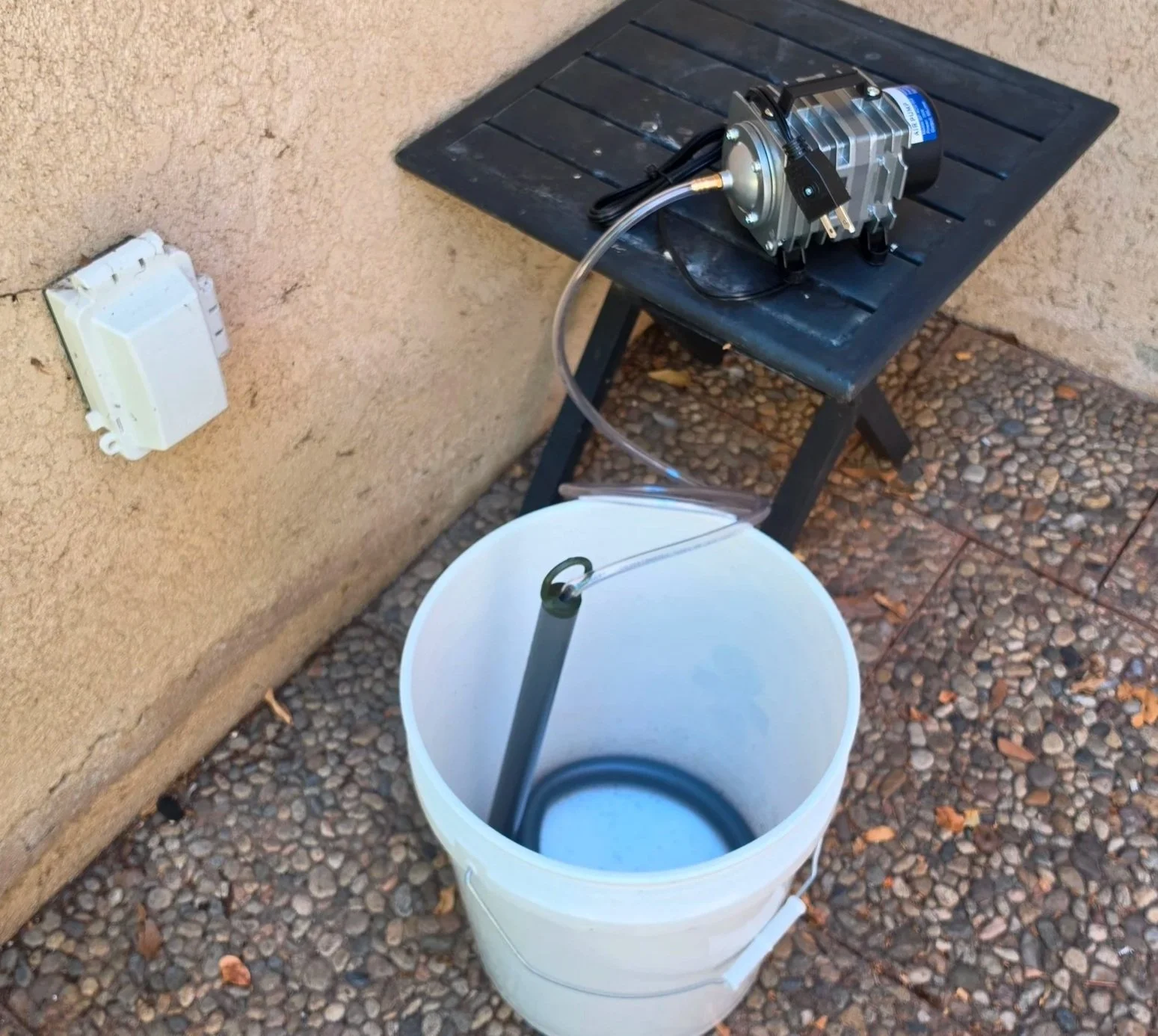
Tea Brewing Station
Here's the setup. That's an air pump up on the stool, with a line running down into the bucket where the castings will steep. (I'd meant to build my own rig, but after one too many mismatched parts and out-of-stock pieces, I waved the white flag and went with this instead.) The air pump is the heart of it — it keeps the water oxygenated so the beneficial (aerobic) microbes multiply instead of the bad ones.
One important step before any castings go in: I run the air pump in plain water for about four hours first. Our tap water carries chlorine, and chlorine will damage the very microbes I'm working to grow — so a few hours of bubbling lets it dissipate before I add the good stuff. Then it's ready to brew. The system runs for about 24 hours, and we have ourselves some good old-fashioned worm tea.
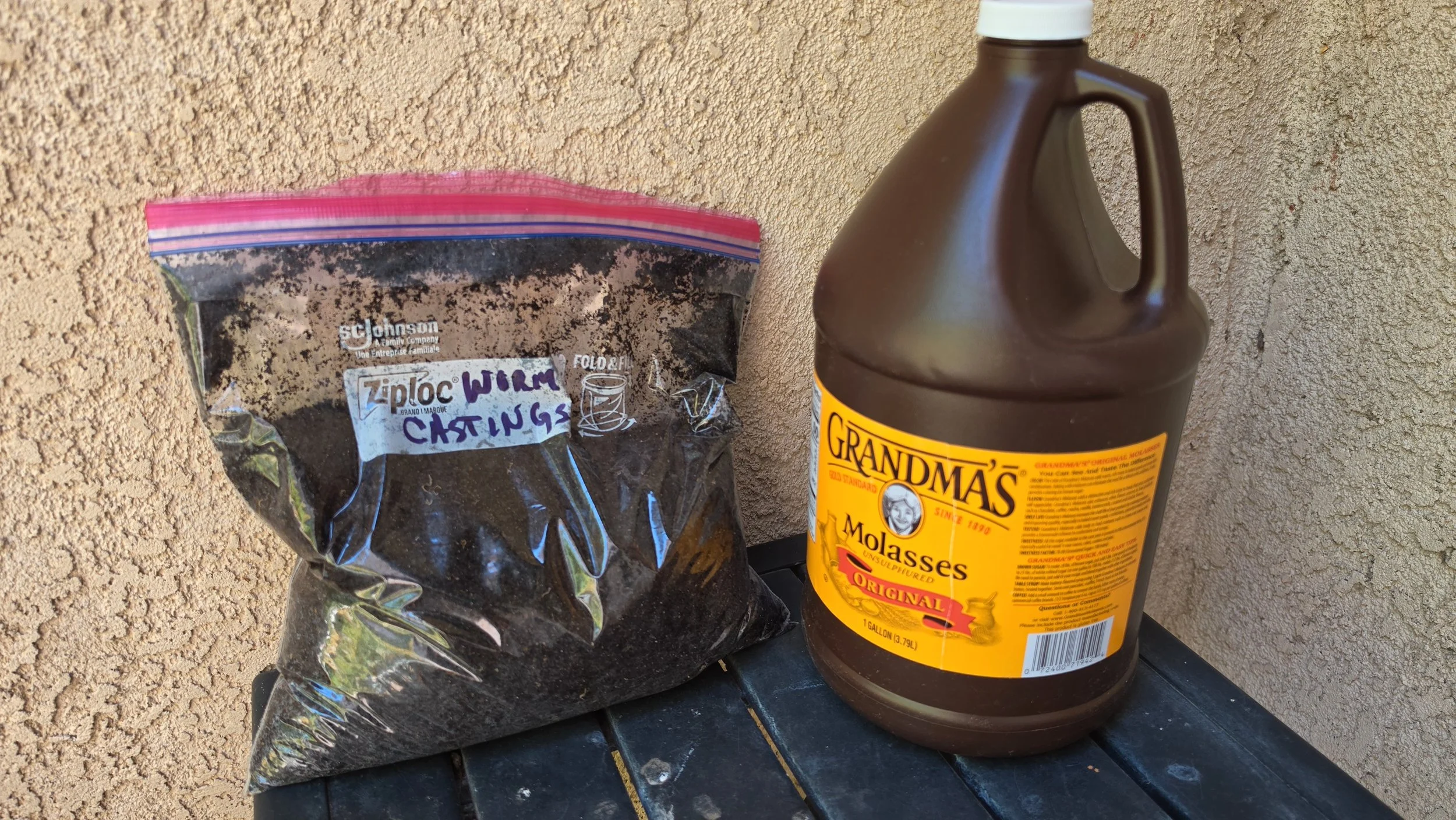
Castings and Unsulfured Molasses
The two key ingredients I've gathered: a bag of worm castings and a jug of unsulfured molasses. The castings bring the microbes; the molasses feeds them while they brew. It works a lot like fermentation, actually — the microbes feast on the sugar and multiply like crazy, and when I pour the finished tea around the garden, I'm delivering all of that beneficial life straight into the soil. One small but important note — the molasses has to be unsulfured. The sulfur in regular molasses can knock back the very microbes you're trying to grow.
And I'll let you in on a little secret: there's a third ingredient going into this brew that I'm not showing here just yet. You'll have to watch my Chapter 2 Hugelkultur video next week to find out what it is.
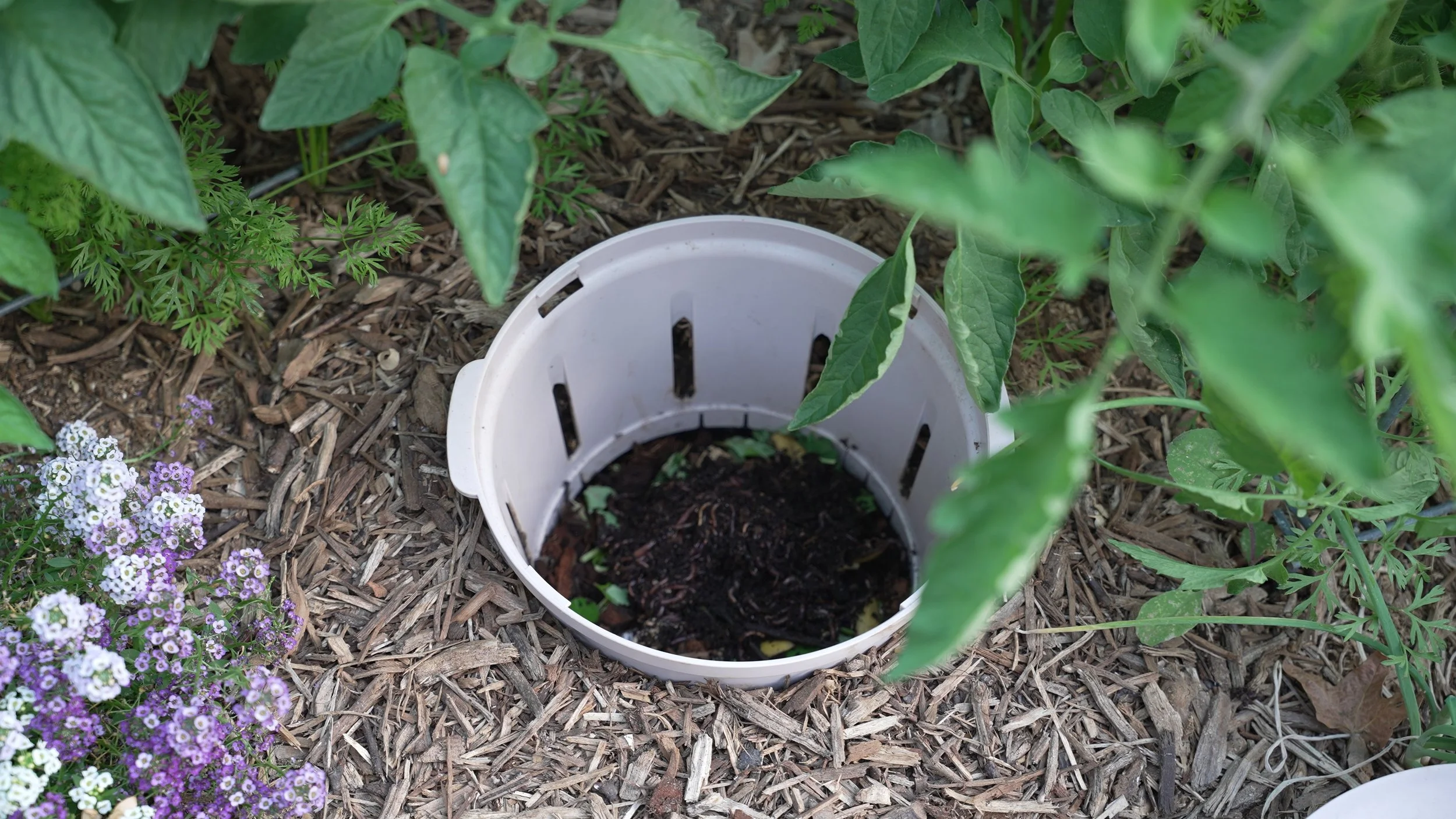
In-Ground Worm Bin
And of course, none of this is possible without the worms themselves. This is an in-ground worm tower sunk right into the bed — the worms move in and out through those slots, eating scraps and leaving castings behind, right where the tomato and carrot roots can reach them.
Here's a fun update for those who've been following along: I added worms to these bins about two months ago, and they promptly left. They seemed to head straight down into the hugelkultur layer of the bed and never came back — all except one or two who decided to stick around. I'm sure the rest are still down there doing good work. But I wanted to get these bins going, so I picked up a fresh batch from my worm farmer friend and added them about a week ago. So far, this group is staying put. Maybe the bin is more inviting now for some reason I can't quite name — but whatever it is, I'm glad to have them hanging around.
I'll be putting the worm tea setup to use and sharing exactly how it goes in my next video. I'm genuinely curious to see the results myself — so we'll learn together. More soon.
Thought of the Week
Every year around this time, I do the same thing to myself. I pile my plate high — more classes, more programs, more projects — and then, somewhere in the thick of it, I catch myself complaining about how busy I am.
I've been doing this long enough now to see the pattern. And this year, I'm trying to catch the complaint before it leaves my mouth, because the truth underneath it is something much better than "tired." I am fortunate. Every one of these commitments exists because someone placed their trust in me — my students, the subscribers who show up here each week, my colleagues, the administration at Mt. SAC who hand me section after section of the garden classes, the team at the HSR program. That trust is a gift.
Last week, in our Regenerative Gardening class, we sat with Principle 8: ask what you can give, rather than what you can take. We talked about how much of it comes down to framing — how the same garden can feel like a list of chores or like a relationship, depending on the question you bring to it. And it strikes me that being thankful for a busy season is just that same principle turned toward my own life. I can frame these next two months as so much being taken from me, or as so much being given to me. Both are true. I only get to live inside one of them.
Because here's what I keep coming back to: how we frame things in our minds quite literally builds the world we live in. The facts of my summer won't change. But the world I experience while moving through it absolutely will, depending on the story I choose to tell about it.
So I'll leave you with the question I've been asking myself lately: What world do I want to live in?
Then we create it. We all have that power.
